
刷脸签到
在中国很多健身房不用卡,看一下摄像头就签到了。
Many gyms in China don't use cards. You look at the camera, and you're checked in.
我每天下班去健身房刷脸签到。
I check in at the gym with my face every day after work.
Virtual Life Quests · Expression Book
Every underlined expression from the quests in one booklet — pinyin, English, a short explanation and an example. Download and print it.
EachTone · HSK 2–3
Virtual Life Quests
All 322 underlined expressions from the quests: pinyin, English, a short explanation and an example. After a quest, turn to its chapter to review.
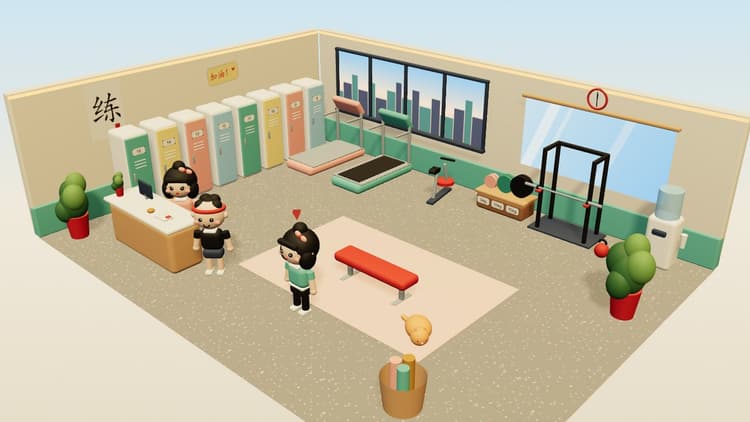
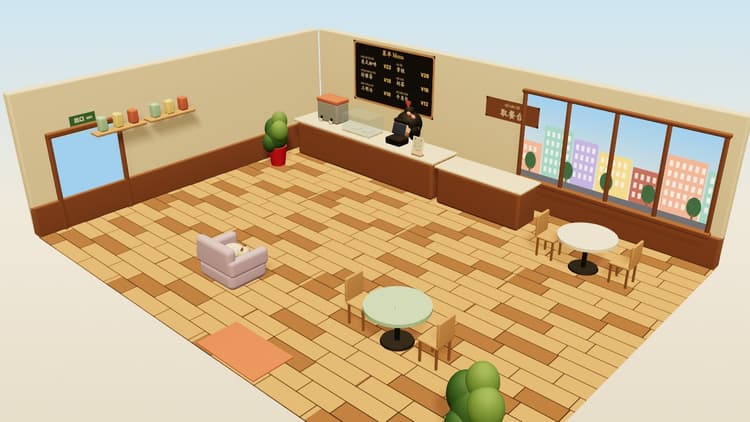
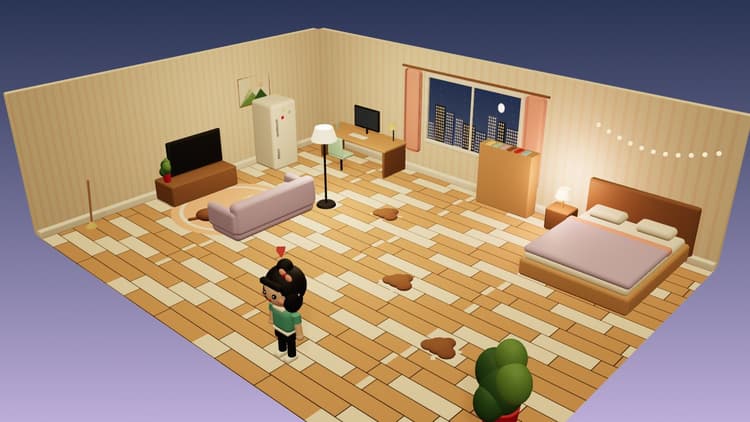
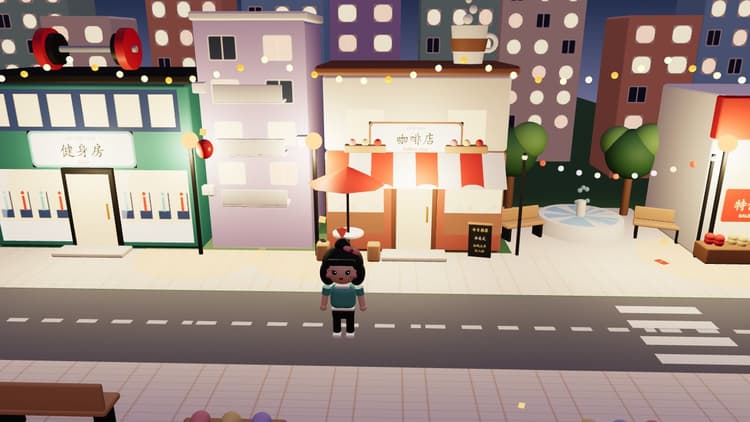
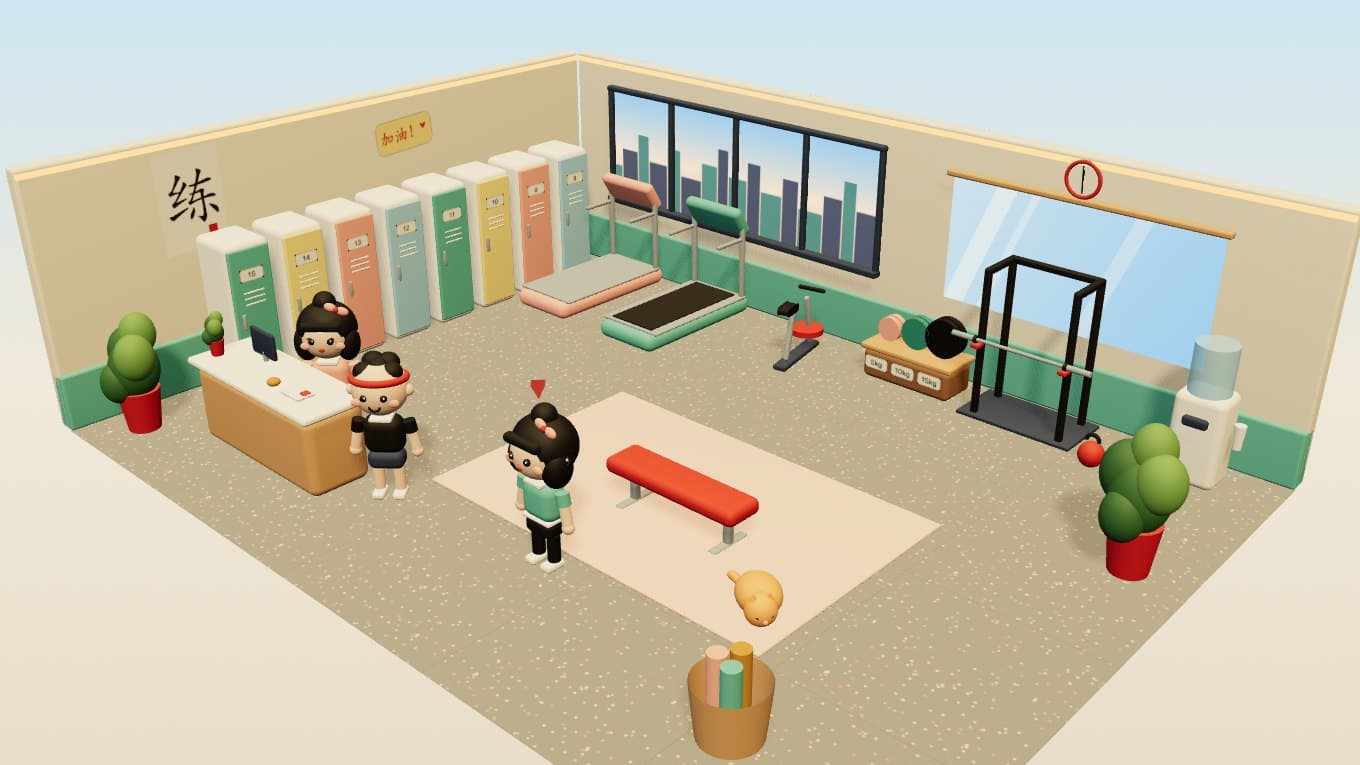
Glute day at the gym
Many gyms in China don't use cards. You look at the camera, and you're checked in.
I check in at the gym with my face every day after work.
Gym cards: 月卡 (one month), 季卡 (three months), 年卡 (one year).
A month card is 200 kuai. A year card is 2,000.
还有 + number = how much is left: 还有16天, 还有两组.
My year card has three months left.
练 + body part = train that part: 练腿 (legs), 练背 (back), 练胸 (chest). People often train glutes and legs together.
Back today, glutes and legs tomorrow.
number + 号 = number …: 几号?十二号。
What's your room number?
Warm up before sport, or you can get hurt.
Warm up before you run.
调到 + number = set it to a number: speed, temperature, volume.
Set the air conditioner to 26 degrees.
太 + adjective + 了 = too …: 太慢了, 太贵了.
adjective + 一点 = a bit more …: 快一点, 慢一点. Northern speakers say 一点儿, with 儿 joined onto the sound before it.
Can you speak a bit slower, please?
adjective + 一点 = a bit more …: 快一点, 慢一点. Northern speakers say 一点儿, with 儿 joined onto the sound before it.
热身 = 热 + 身. To say you've finished, people often say the verb twice: 热身热好了, 吃饭吃好了.
I've finished eating. Let's go!
The big rack for squats and deadlifts.
一边 + number = that many on each side.
Two people sit on each side of the table.
公斤 = kg. 1 公斤 = 2 斤.
I want to lose three kilos.
太 + adjective + 了 = too …
先……再…… = first …, then …: 先热身,再练.
Eat first, then do your homework.
A long bar with plates on both ends. 哑铃 (dumbbells) are small: one in each hand.
A barbell move for glutes and legs: push your hips back, keep your back straight.
At the gym: 组 = set, 个 = rep. 一组八个,做三组 = 3 sets of 8.
I do three sets of push-ups every day.
还有多少 + measure word? = how many are left? 还有多少组?还有多少天?
How many days are left on your month card?
When you can't do any more, the coach shouts 坚持住!
Last five, hang in there!
把 + thing + 放在 + place = put it there: 把手机放在桌子上.
Please put the book in your school bag.
接水 = get water from a water dispenser or a tap. 点 = 一点儿 (a little).
I'm going to get some water.
verb + 得 + how = how well you do it: 练得不错, 说得很好.
Your Chinese is really good!
别 + verb = don't …: 别迟到, 别忘了.
Class is at eight tomorrow. Don't be late!
在 + verb = doing it right now.
The kitten is sleeping. Don't wake it up.
Say 叫我…就行 to tell people what to call you, in a friendly way.
Just call me Xiao Wang.
别 + verb = don't …: 别看我, 别说话.
Class has started. Don't look at your phone!
核心 = your core (belly and lower back). 收紧 = tighten. Coaches say this all the time.
感受…发力 = feel that muscle doing the work. For glutes: 感受臀部发力.
多 + verb = do more; 少 + verb = do less.
Eat more vegetables, less meat.
…就对了 = that's how it should be. Coaches love this one.
每天 + time = something you do every day.
I go to bed at ten every night.
还不 + adjective = not … yet.
I'm not hungry yet.
verb + 完 + 再 … = finish this, then do that.
Finish eating, then go.
等一下 = in a moment, not now.
Wait a moment, I'm coming!
别着急 = take your time, don't worry.
Don't rush. There's still time.
已经 + verb + 好了 = already done.
I've already made dinner.
有点儿 + adjective = a bit … (often something not so good).
This top is a bit expensive.
加油! = come on, you can do it!
来得正好 = you came at just the right time.
one + measure word + price: 一瓶三块 = 3 kuai a bottle.
Bubble tea is 15 kuai a cup.
记得 + verb = remember to … (don't forget).
Remember to take your keys when you go out.
记住了 = I've got it, I won't forget.
I've remembered your phone number.
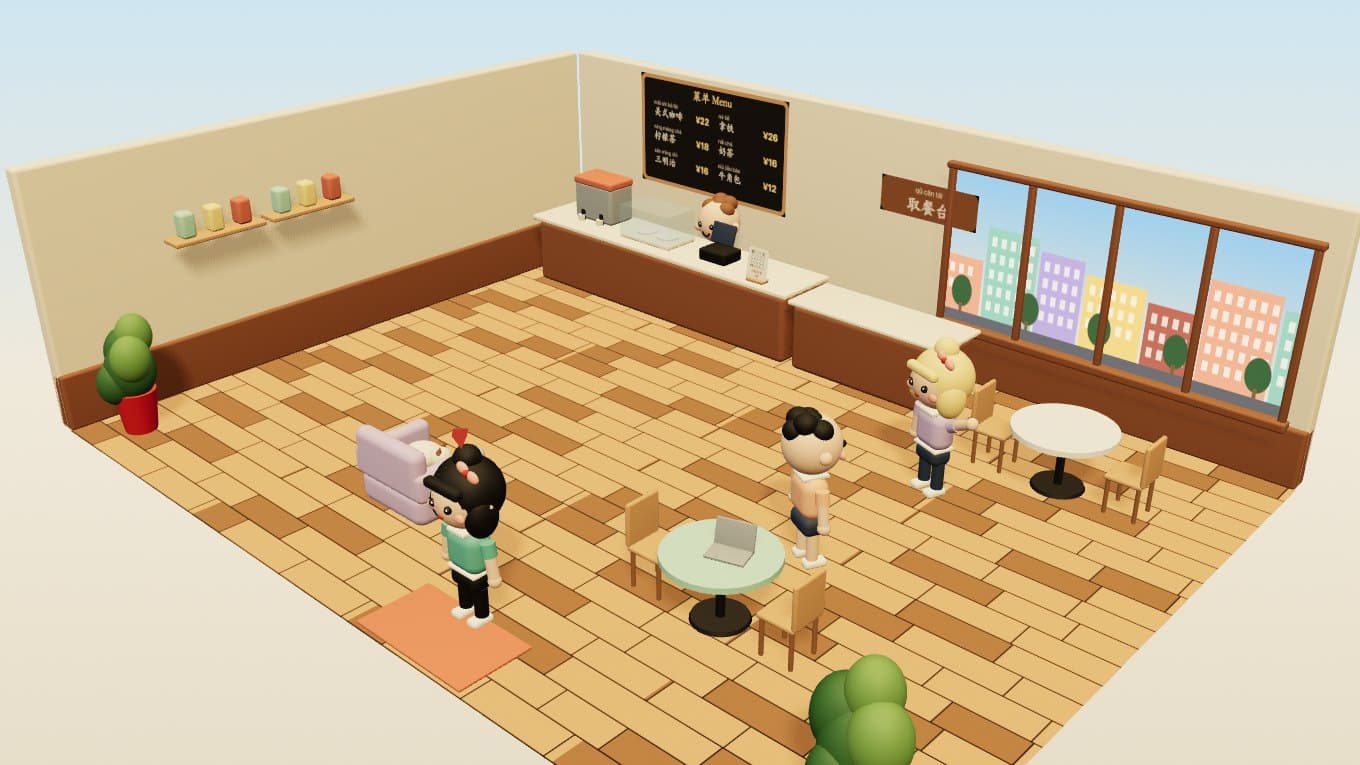
Coffee shop: what's today's order?
占座 = save a seat for yourself and your friends.
It's hard to get a seat in the library.
帮我带 + thing = buy one for me while you're there.
If you go to the supermarket, get me a bottle of water.
冰 + drink = the iced one: 冰美式, 冰拿铁.
In summer I only drink iced Americano.
小杯 small, 中杯 medium, 大杯 large.
I usually have a medium.
How sweet: 无糖 none, 少糖 less, 正常糖 regular.
I always get my milk tea with less sugar.
再 = one more / again. When ordering: 再要一个…
Can you say it again, please?
Put 请问 in front of a question to be polite.
Excuse me, where is the restroom?
A 还是 B? = A or B? Use it when asking someone to choose.
Do you like coffee or tea?
打包 = to go. In a restaurant it also means packing up leftovers.
We can't finish this — let's pack it up.
A shop's card: things cost a bit less, and you collect points.
This supermarket's membership card is free.
In China you often order and pay by scanning a QR code with your phone.
This place only takes orders by QR code.
优惠 = a deal: cheaper, a discount, or something free.
Is there a student discount?
打八折 = you pay 80% of the price. 100 kuai → 80 kuai.
This top is 10% off.
After you pay you get a number. When it's called, go and pick up.
What's your pickup number?
稍 = a little. 请稍等 is a polite "please wait".
Just a moment, I'll be right there.
…好了 = it's ready, come and get it.
Dinner's ready, come and eat!
28 (二十八) and 82 (八十二) sound alike — listen to the first number.
转 = send money by WeChat or Alipay.
I sent you the money for dinner.
请 can mean "I'll pay": 我请你喝咖啡 = coffee's on me.
Dinner's on me tonight.
下次 next time; 这次 this time; 上次 last time.
See you next time!
不着急 = take your time.
Take your time eating, no rush.
verb + 完 = finished: 卖完了 sold out, 吃完了 eaten up.
The milk's all gone — I'll buy more tomorrow.
有人 here means someone is sitting here. Ask: 这儿有人吗?
Excuse me, is anyone sitting here?
…就够了 = that much is enough, no more needed.
For one person, one bowl of rice is enough.
How sweet it is. You often choose it for milk tea or juice.
This milk tea is just sweet enough.
Shop staff often ask this: do you want anything else?
No thanks, that's all.
When a guest leaves, staff often say 慢走: take care on your way.
Thanks for coming, take care!
早点 = a bit earlier. Also 晚点 (later), 快点 (faster).
Come a bit earlier tomorrow.
带去 + place = take something there.
I take my lunch to the office.
有点 + a not-so-good feeling: a bit cold, a bit tired, a bit pricey.
This piece of clothing is a bit expensive.
46 and 64 sound alike — listen to the first number.
Someone you work with.
I have lunch with my coworkers.
A 让 B do… = A asks B to do something.
Mom told me to come home early.
Counting: 一杯, 两杯 — never 二杯.
Two glasses of water, please.
With money, the number after 块 is tenths: 六十三块二 = ¥63.20.
Apples are 3.50 a jin.
17 and 70 sound alike — listen to the first number.
The morning meal. Lunch is 午饭, dinner is 晚饭.
What did you have for breakfast?
换 = swap this one for another one.
This one is too small. Can I swap it for a bigger one?
Feeling good in body or mind.
This chair is very comfortable.
39 and 93 sound alike — listen to the first number.
去冰 = no ice cubes, but still cold. 少冰 = less ice.
Less ice in my lemon tea, please.
No sugar at all.
I only drink sugar-free.
15 and 50 sound alike — listen to the first number.
也 goes before the verb: 我也喝 = I'll drink it too.
If you go, I'll go too.
The first cup is full price, the second costs half.
At this shop the second cup is half price on Fridays.
You pay little and get a lot.
This is 50% off — a really good deal.
One of two equal parts.
Let's have half of this cake each.
24 and 42 sound alike — listen to the first number.
The numbers or letters you type to get into a phone or onto Wi-Fi.
What's your phone password?
Where you plug things in on the wall.
Is there a socket here?
八个八 = 88888888. People say passwords and phone numbers like this.
Put power back into a phone or computer.
My phone is dead, I need to charge it.
13 and 30 sound alike — listen to the first number.
In a little while.
I'll call you in a bit.
练 = practise, train. At the gym: 练腿 legs day, 练臀 glutes day.
I work out for half an hour every day.
Cheering someone on: go for it, you can do it!
Exam tomorrow — good luck!
58 and 85 sound alike — listen to the first number.
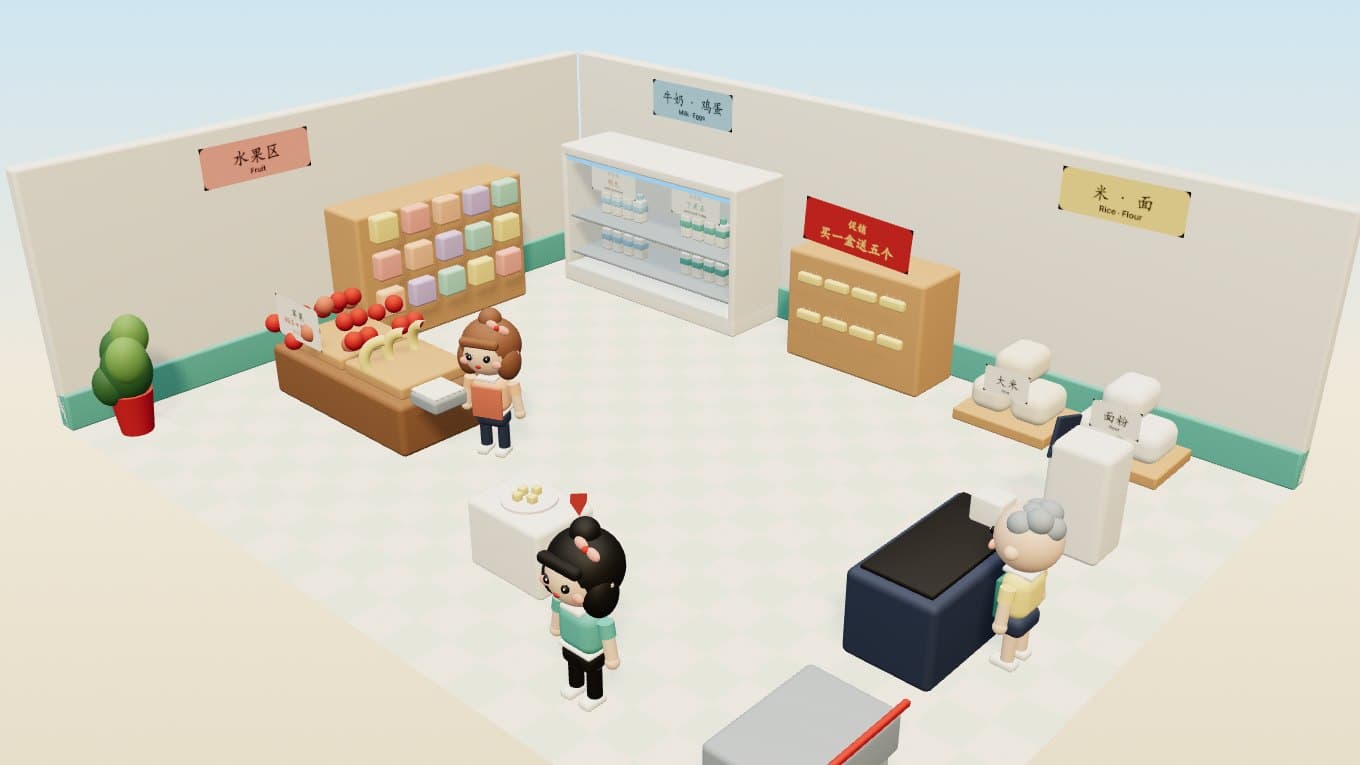
Supermarket: shopping for your roommate
number + measure word + thing. 斤 is a weight: 1 斤 = 500 g.
I'd like one jin of apples.
瓶 = bottle: 一瓶水, 两瓶牛奶.
He bought two bottles of milk.
盒 = box: 一盒鸡蛋, 一盒饼干.
I had a pot of yogurt this morning.
袋 = bag: 一袋米, 一袋面包.
Mum asked me to buy a bag of rice and a bottle of soy sauce.
The cart you push. The small one you carry is 购物篮.
Can kids sit in the shopping cart?
Asking a price: …怎么卖? (at markets and supermarkets).
How much is the watermelon?
price + 一 + measure word: 五块钱一斤 = 5 kuai per jin.
打折 = on sale, cheaper than usual.
When do supermarkets usually have sales?
按 + measure word + 卖 = sold by…
Are eggs sold by the piece or by the jin?
一共 = altogether, in total.
How much is it altogether?
Shop assistants ask this. Answer: 还要… or 就这些.
区 = a section: 水果区, 蔬菜区.
The snacks section is upstairs.
过期 = past its date.
This milk has expired — don't drink it!
How long food keeps. Check it on milk and bread.
Do you check the date when you buy milk?
促销 = a promotion: discounts, free extras.
What special offers does the supermarket have?
买…送… = buy this, get that free.
Buy one, get one free!
Flour, for noodles, buns and bread.
You need flour to make dumplings.
就这些 = that's all.
That's all, thanks.
结账 = pay the bill / check out.
Waiter, the bill please!
Where you pay. Staffed checkouts or self-checkout.
Do you prefer a staffed checkout or self-checkout?
In China people pay with WeChat or Alipay on their phone.
Do you pay by scanning with your phone?
自己带 = bring your own.
I always bring my own bag to the supermarket.
A common offer of help. Reply: 不用了,谢谢。
排队 = stand in line.
Do you play on your phone while queueing?
verb + 一 + verb = have a go: 尝一尝, 看一看.
Have a taste, it's delicious!
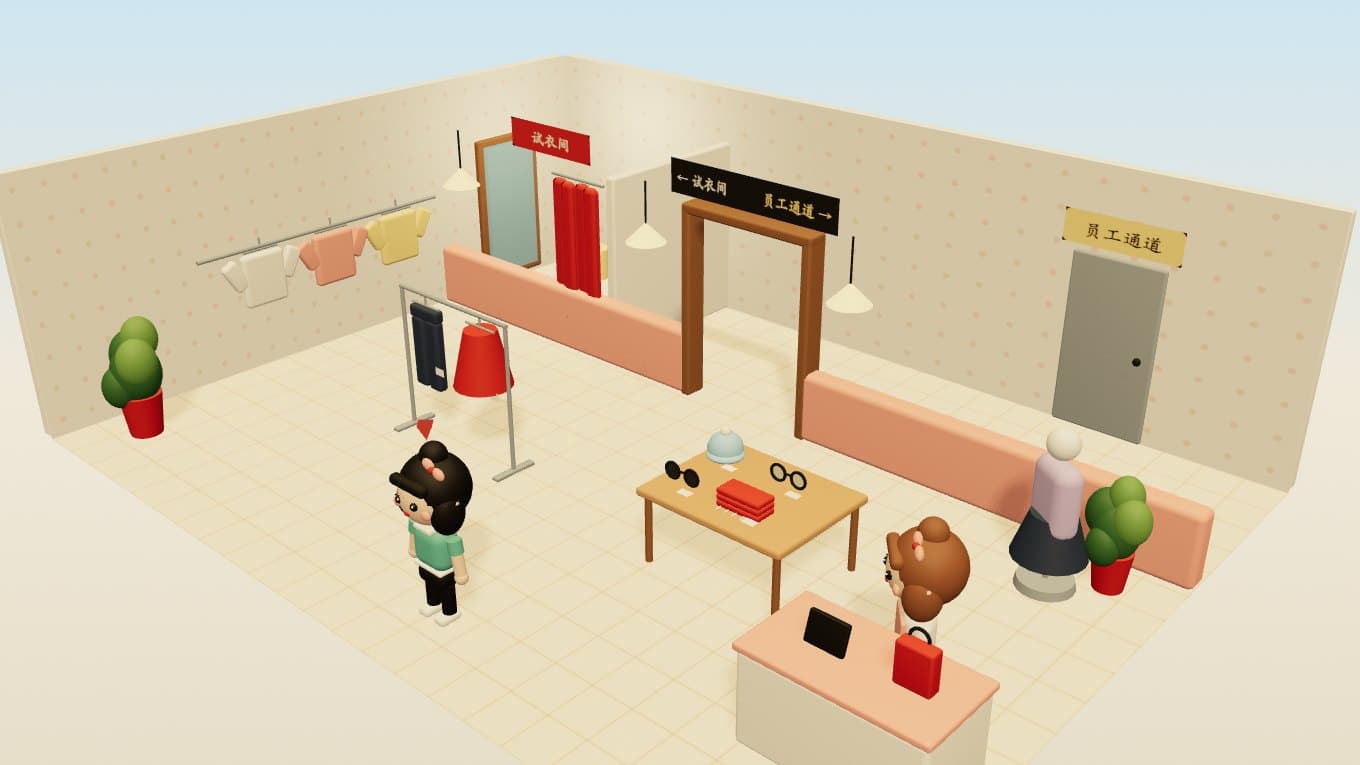
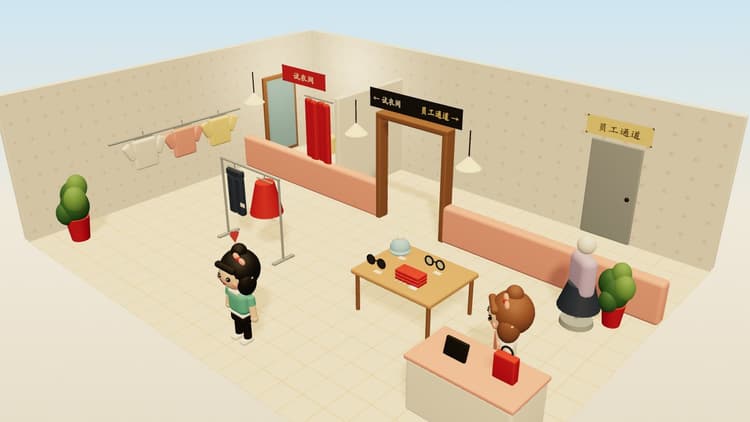
Clothes shop: buying clothes
Put it on to see if it fits.
Can I try on this skirt?
To ask if there is: 有没有 + thing? No 吗 at the end.
Do you have a bigger one?
Clothing size: S, M, L.
I wear a medium.
Trousers and skirts take 条.
These trousers are a bit long.
只有 + thing = there's only this, nothing else.
I only have ten yuan.
Verb + 一下 = do it once, briefly — sounds polite.
Can I try it?
The little room in a shop for trying clothes on.
There's a mirror in the fitting room.
Keep walking forward, don't turn.
Go straight for five minutes and you're there.
Turn left. Turning right is 右拐.
Turn left at the next crossing.
Hats take 顶: 一顶帽子.
I'd like to buy a hat.
Glasses take 副 (a pair): 一副眼镜.
I'd like to buy a glasses.
Pay after shopping or a meal.
Waiter, the bill please!
What you look at yourself in.
Check the mirror before you go out.
A way only the shop's staff may use.
Staff passage — no customers.
Look at yourself in a mirror.
She checks the mirror every day before going out.
挺 + adjective + 的 = quite..., very common in speech.
This shop is quite cheap.
有点儿 + adjective, when you're not happy with it. Read 儿 joined to 点.
It's a bit cold today.
不太 + adjective — softer than plain 不.
This dish isn't very spicy.
慢慢 + verb = take your time doing it.
Eat slowly, no rush.
What shop staff say as you leave.
Thank you, please come again!
钱不够, 时间不够 — less than you need.
I don't have enough to buy this one.
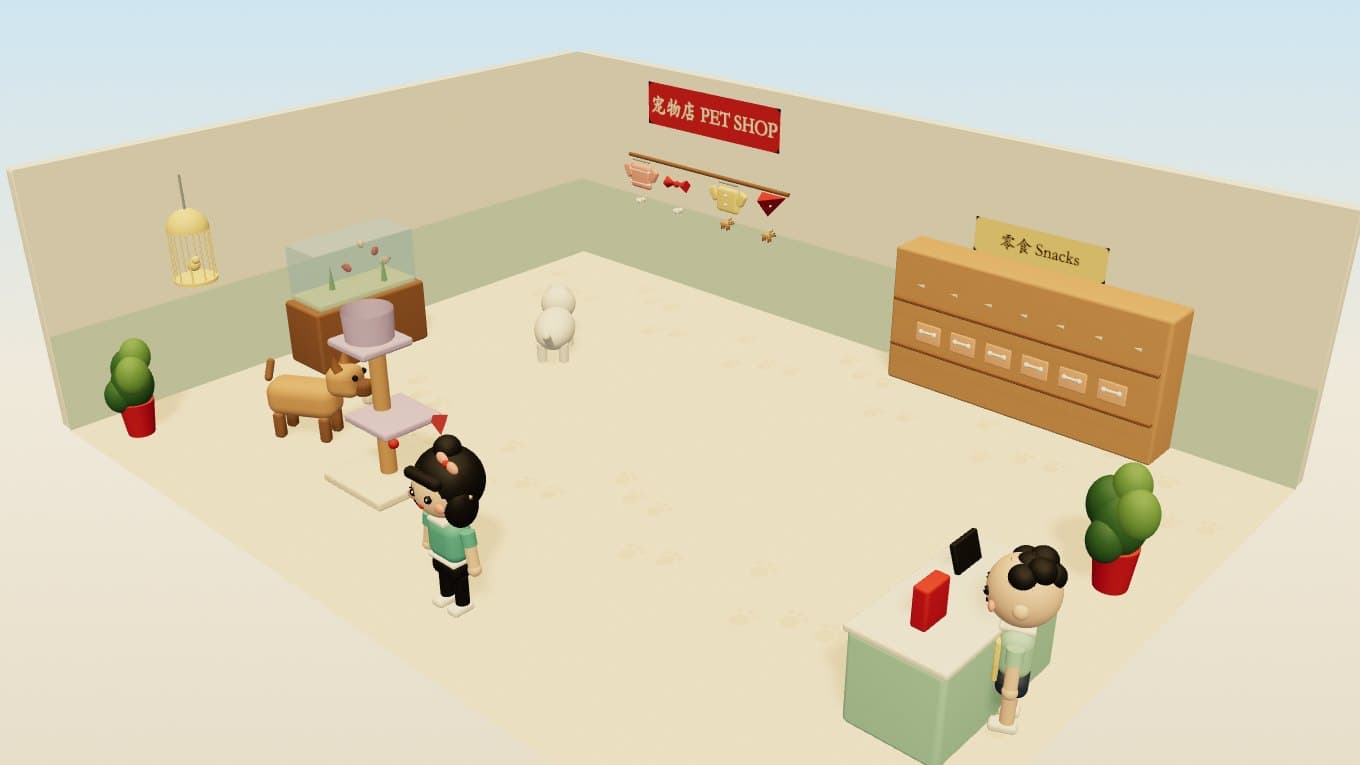
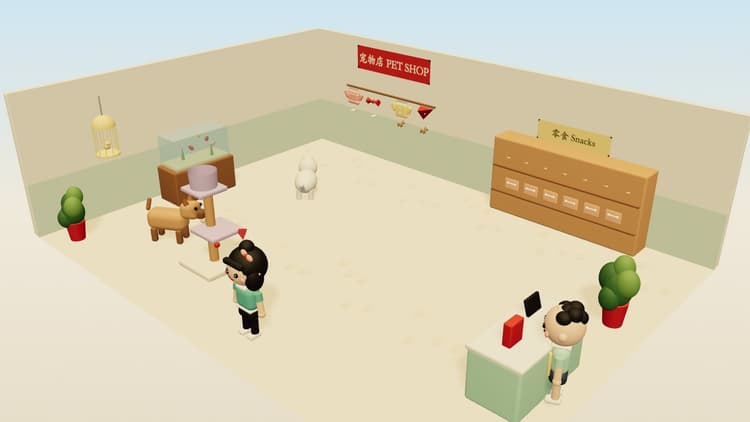
Pet shop: treats for Mimi and Diudiu
Sweet and lovable — like kittens, puppies, little kids.
This puppy is so cute!
Asking a name: 你叫什么名字? 它叫什么名字?
What's your cat's name?
Shop staff say this: no rush, just look.
Take a look — try anything you like.
Little things to eat between meals.
I like snacking in the evening.
给 + someone + verb: doing it for someone. 给 + someone comes BEFORE the verb.
I want to buy my mum some clothes.
Not too big, not too small — just right.
These shoes fit me just right.
Hats, glasses, bows take 戴: 戴上.
It's cold — put your hat on.
给 + someone + verb: doing it for someone. 给 + someone comes BEFORE the verb.
I want to buy my mum some clothes.
Water falling from the sky.
It'll rain tomorrow — take an umbrella.
Good-looking (for boys, or a cool dog).
You look so cool today!
要不要 + verb? — asking if someone wants to.
Do you want to go eat together?
Small dried fish — cats love them.
Mimi wants dried fish every day.
What dogs love to chew.
Diudiu hid his bone.
Verb + 反了 = got it the wrong way round.
Your top's on inside out!
Doubled verbs (尝尝, 看看, 试试) sound light and casual.
Have a taste of this dish.
Verb + 得 + how: says how something is done.
The kids are having a great time.
Everything added up.
Three people altogether.
The next time.
See you next time!
Choose one from many.
Help me pick one.
A glass tank for keeping fish.
We have a fish tank at home.
Very sure.
You'll definitely like it here.
Nice and warm, not cold.
It's warm today.
Verb + 得见 = can hear / can see. 听不见 = can't hear.
Can you hear me?
Soft to the touch.
This pillow is soft.
Cool, stylish. Casual word.
Your new shoes are so cool!
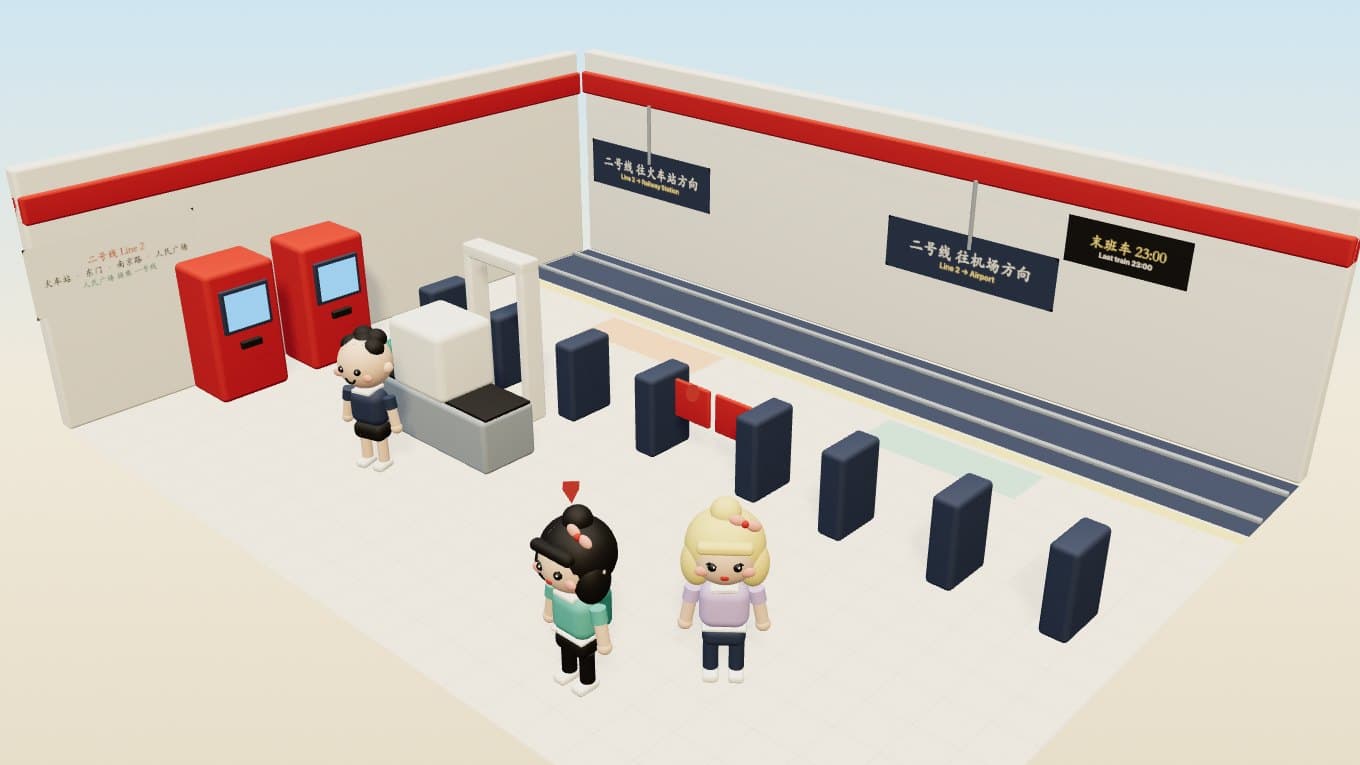
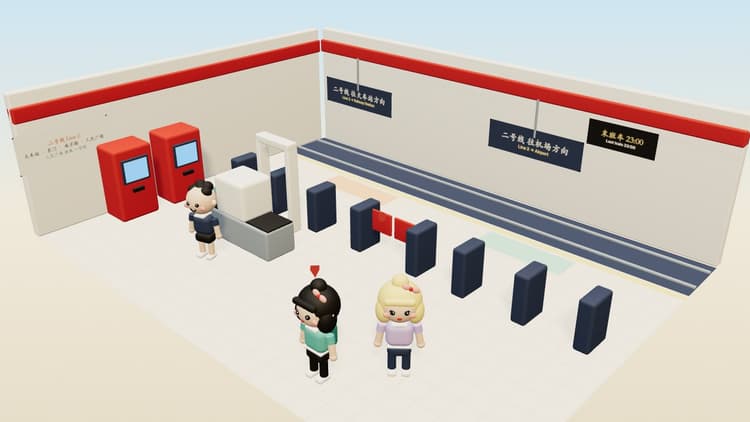
Metro: taking the metro
坐 + vehicle: 坐地铁, 坐公交. 打车 = take a taxi.
Do you often take the metro?
又 A 又 B = both A and B.
This high-speed rail station is big and clean.
Rush hour: 早高峰 morning, 晚高峰 evening.
Do you take the metro at rush hour?
The card for the metro and buses. Phones work too.
Where can I top up my transit card?
A one-way ticket. A return ticket is 往返票.
When you buy plane tickets, one-way or return?
A machine where you buy tickets yourself.
…就行 = that's enough, that'll do.
Just give me a call, that's enough.
安检 = security check. 过安检 = go through it.
Do you find security checks annoying?
verb + 上去 = up / onto: 放上去, 走上去.
Put the suitcase up there.
也 = too. Said with a bit of surprise: even the metro needs security?
每个 + noun + 都 = every … without exception.
Every student has a book.
进站 = go into the station; 出站 = come out.
After you go in, queue to board.
几号线 = which line: 一号线, 二号线.
Which line is nearest your home?
往 + place + 方向 = in the direction of …
Is this the way to the railway station?
verb + 反 = done the wrong way round: 坐反了, 穿反了.
I put my top on inside out today.
What you hear on trains: the next stop.
Is the next stop People's Square?
好 + adjective + 啊 = so …! 挤 = crowded.
The rush-hour metro is so crowded!
换乘 = change lines.
Excuse me, where do I change to Line 3?
才是 = it's that one, not this one.
跟着 … 走 = follow …
Follow me — don't get lost.
The last train of the day.
Have you ever taken the last train?
Walk around the shops, look and buy.
I often go shopping with friends at the weekend.
坐 + number of stops: 坐一站, 坐三站.
It's just two stops.
The middle of the city, the busiest part.
I live in the city centre — it's easy to get anywhere.
The doors of a bus or train.
The doors are closing — get on!
Lots of people and noise, in a fun way.
The night market is very lively.
好 + adjective = very ..., common when talking.
It's so hot today!
A place to sit.
There are no seats left — I'll stand.
A short time. Read 儿 joined to 会.
He'll be here in a moment.
The last stop on the line; the train goes no further.
This is the last stop — everyone off, please.
Things you carry: bag, phone, keys.
Don't forget your things when you get off.
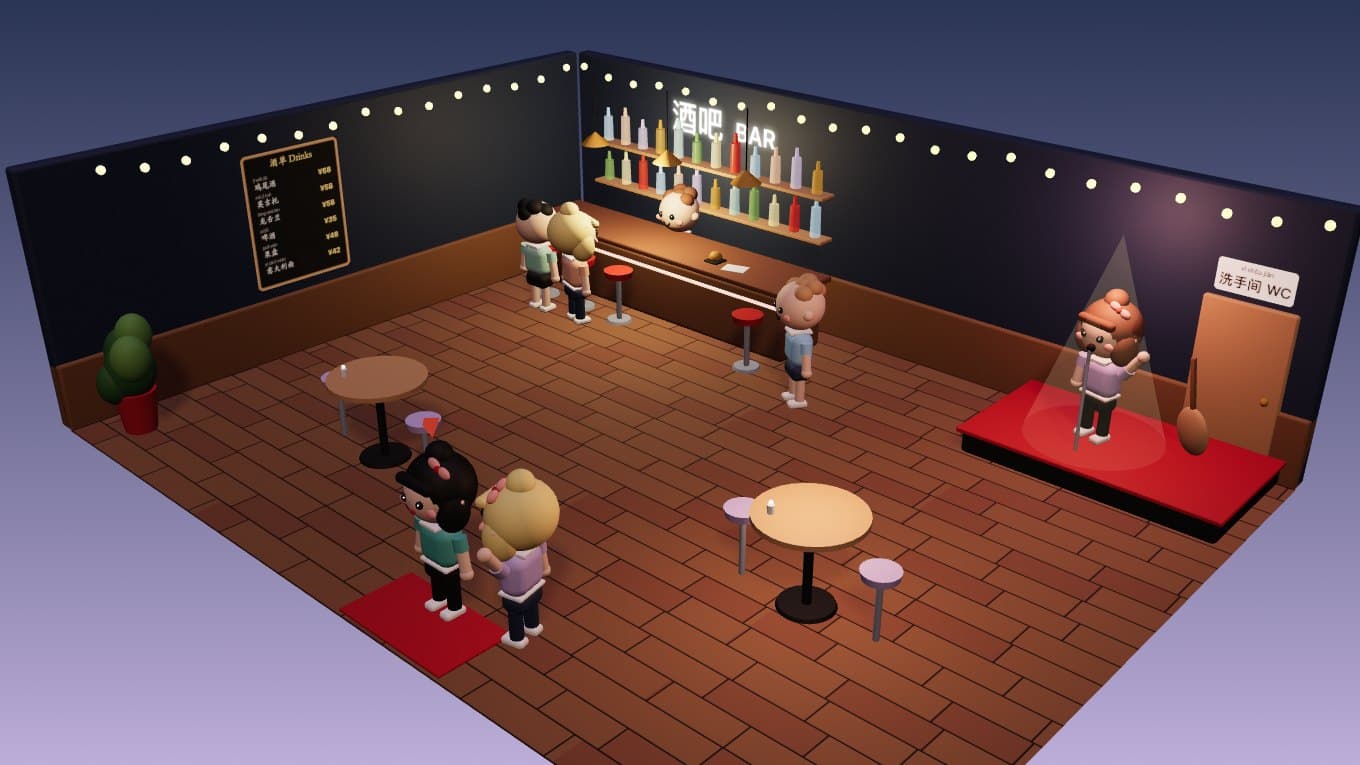
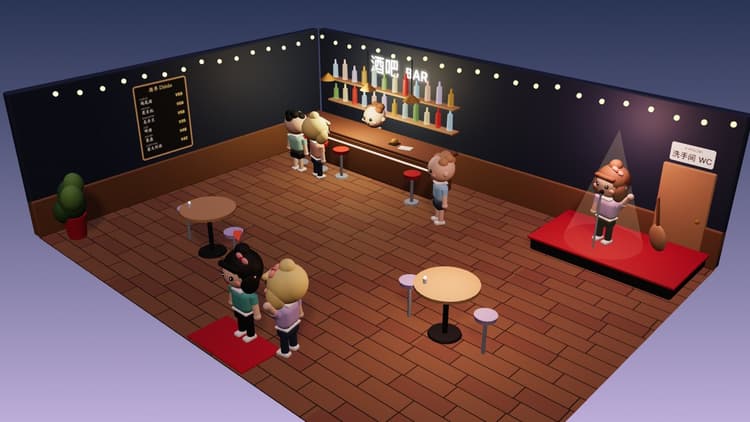
Bar: Friday night
A strong spirit from Mexico.
厕所 = toilet. 洗手间 sounds a little more polite.
Excuse me, where's the toilet?
喝多了 = had too much to drink.
He drank too much last night.
A drink with no alcohol — it won't get you drunk.
Do you like alcohol-free drinks?
verb + 不了 = can't (do it): 喝不了, 去不了, 吃不了辣.
I'm busy tomorrow, I probably can't go.
A drink with a lot of alcohol is 烈酒, a strong spirit.
I can't drink very strong spirits.
都 = both / all of them.
Are they all here?
When ordering, 来一杯 / 来一个 = I'll have one.
Boss, a bowl of noodles!
Ice in a drink.
Do you like ice in your drinks?
Small things to eat: fries, a fruit plate, fried chicken…
What's the most famous snack in your country?
A plate of cut fruit — often ordered in bars and karaoke.
Let's get a fruit plate.
份 = one portion: 一份沙拉, 两份意大利面.
One fried rice, please.
In China people mostly pay by phone: WeChat or Alipay.
Do you pay with WeChat or Alipay?
有人 here means someone's sitting there. Ask this before you sit next to someone.
Excuse me, is this seat taken?
是……的 tells who / when / how something already happened.
I came by metro.
多久 = how long (多长时间).
How long does it take from your home to work?
number + 个多月 = a little more than that: 三个多月, 一年多.
I've studied Chinese for just over a year.
verb + 得 + how: 说得很好, 跑得很快, 睡得不好.
You dance really well!
Not great, not bad. When praised, Chinese people often say 没有没有,一般般.
The coffee here is just so-so.
加微信 = add someone on WeChat. 加个微信 sounds more casual.
Let's add each other on WeChat.
When adding on WeChat, one person shows a QR code and the other scans it.
You scan mine.
刚 = just now: 刚认识, 刚到, 刚吃完.
I just got here — where are you?
Say 干杯 when you clink glasses.
To our friendship — cheers!
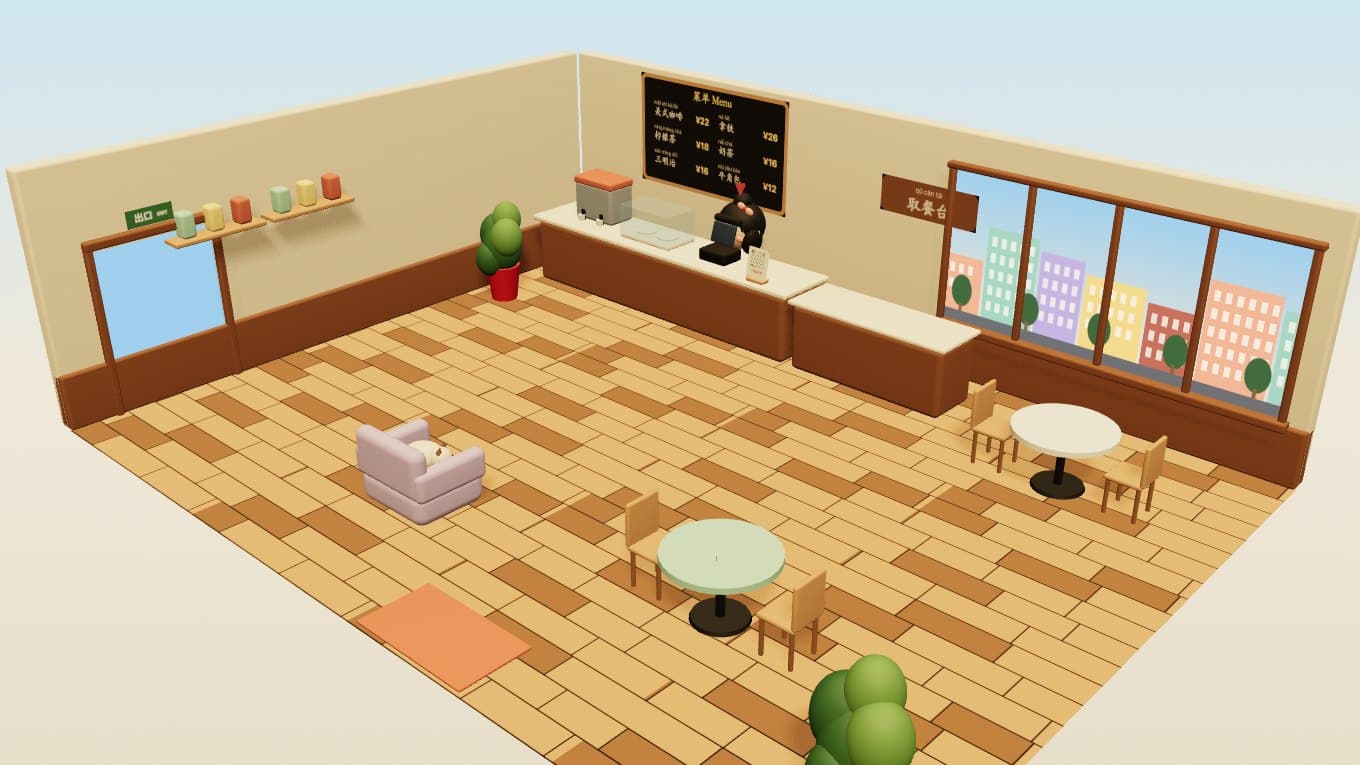
Part-time job: a day at the café
当 + role = work as / be: 当老师, 当店员.
I worked part-time in a café at university.
Say hello to a customer and ask what they'd like.
There's a customer — go and see to them.
Said to someone who has worked hard — thanks for the effort.
Great work today, everyone!
The money you earn by working.
How much do you earn?
Extra money for doing well.
There's a bonus at the end of the year.
Being polite and gentle with people.
He speaks very politely.
To pay. Shops often say 付款.
Can I pay by phone?
Very soon, in a moment.
I'll be there right away.
Everything added up.
How much is it altogether?
After paying, the customer gets a number to collect their order.
What you call the staff in a restaurant or café.
Waiter, the bill please!
Both are OK.
Tea or coffee? Either is fine.
Chinese people often say this to learners. You can answer 哪里哪里 or just 谢谢.
Part-time job: clothes shop assistant
Someone who works in a shop and serves customers.
The staff in this shop are very friendly.
Said to someone after they've worked hard.
You've worked hard today — get some rest.
The right size or style.
These shoes fit me well.
Adjective + 一点 = a bit more so.
Is there a cheaper one?
What you say when bargaining.
Boss, a little cheaper, please!
Part-time job: helping at the pet shop
Help out. 帮忙 stands alone; 帮 + someone + do something.
Can you do me a favour?
Said to someone after they've worked hard.
You've worked hard today — get some rest.
不爱 + verb = doesn't like doing.
My son doesn't like eating greens.
Things in a bag or pack take 包.
I bought two packs of biscuits.
Ask this when you don't know what to do.
I've lost my phone — what do I do?
Doubled verb: a gentle stroke.
Can I pat your dog?
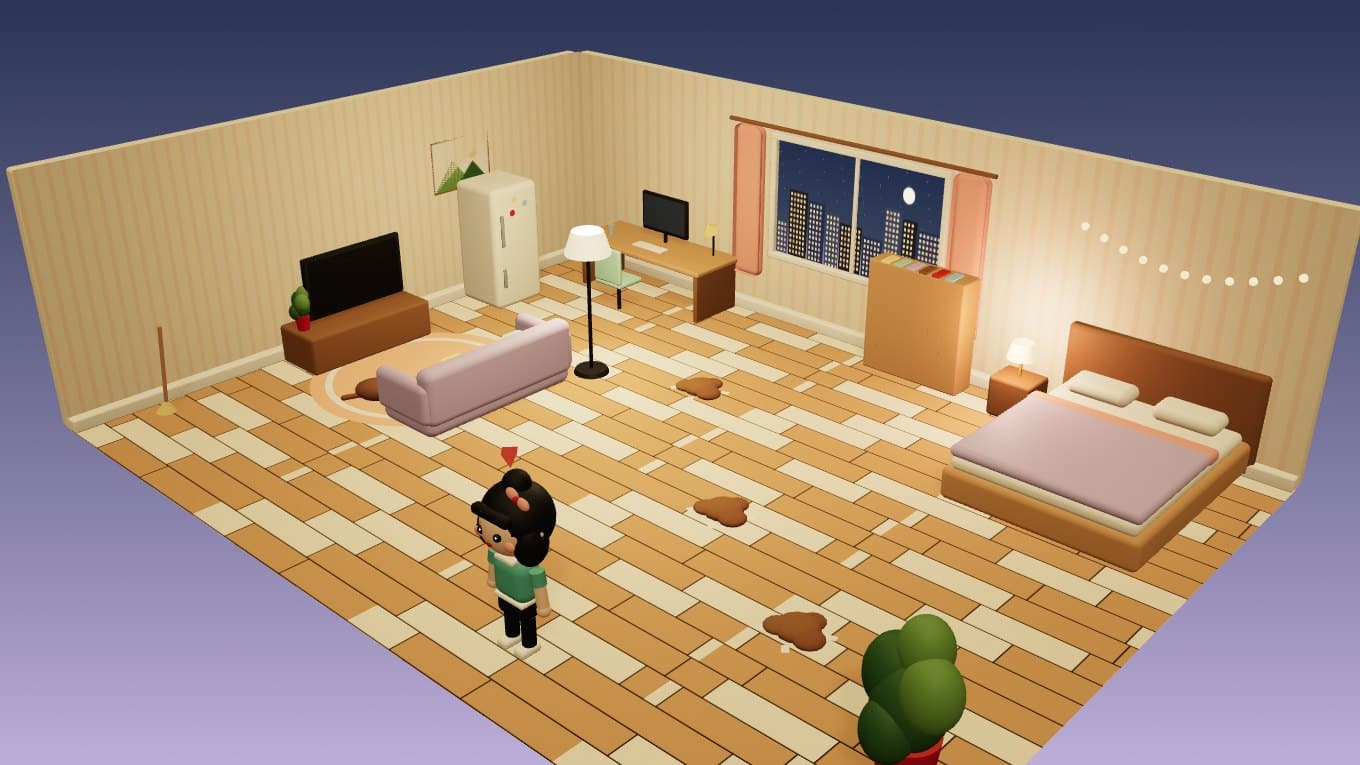
Home: time to rest
After a long time, finally…
I've finally finished my exams!
先 A,再 B = do A first, then B.
Let's eat first, then watch a film.
Not clean.
My shoes are dirty.
扫地 = sweep the floor. Saying the verb twice (扫扫) sounds relaxed: just a quick sweep.
I'll just wash my hands.
No dust, nothing dirty.
The room is very clean.
Use the internet on a computer or phone.
I go online every evening.
The photos and posts friends share on WeChat.
She posted lots of photos on her Moments.
点赞 = tap like on a post.
Everyone liked my post.
The long soft seat at home.
The cat is sleeping on the sofa.
What the TV or your phone says about tomorrow's weather.
Did you check the weather forecast?
No clouds, just sunshine.
It's sunny today.
Wanting to sleep.
I went to bed too late yesterday, so I'm sleepy today.
关 = turn off / close: 关灯, 关门, 关电视. The opposite is 开.
Remember to turn off the lights when you go out.
What you say before going to sleep.
Good night, see you tomorrow!
adjective + 不 + adjective makes a question: 饿不饿? 累不累?
Are you cold?
冰 cold + 箱 box: the box that keeps food cold.
Put the milk in the fridge.
Give plants a drink.
I water the flowers every day.
Push off the ground and go up or forward.
The puppy jumps really high.
过来 = come over here. 过去 = go over there.
Come here a sec.
Dogs wag their tails when they're happy.
The puppy wags its tail as soon as it sees me.
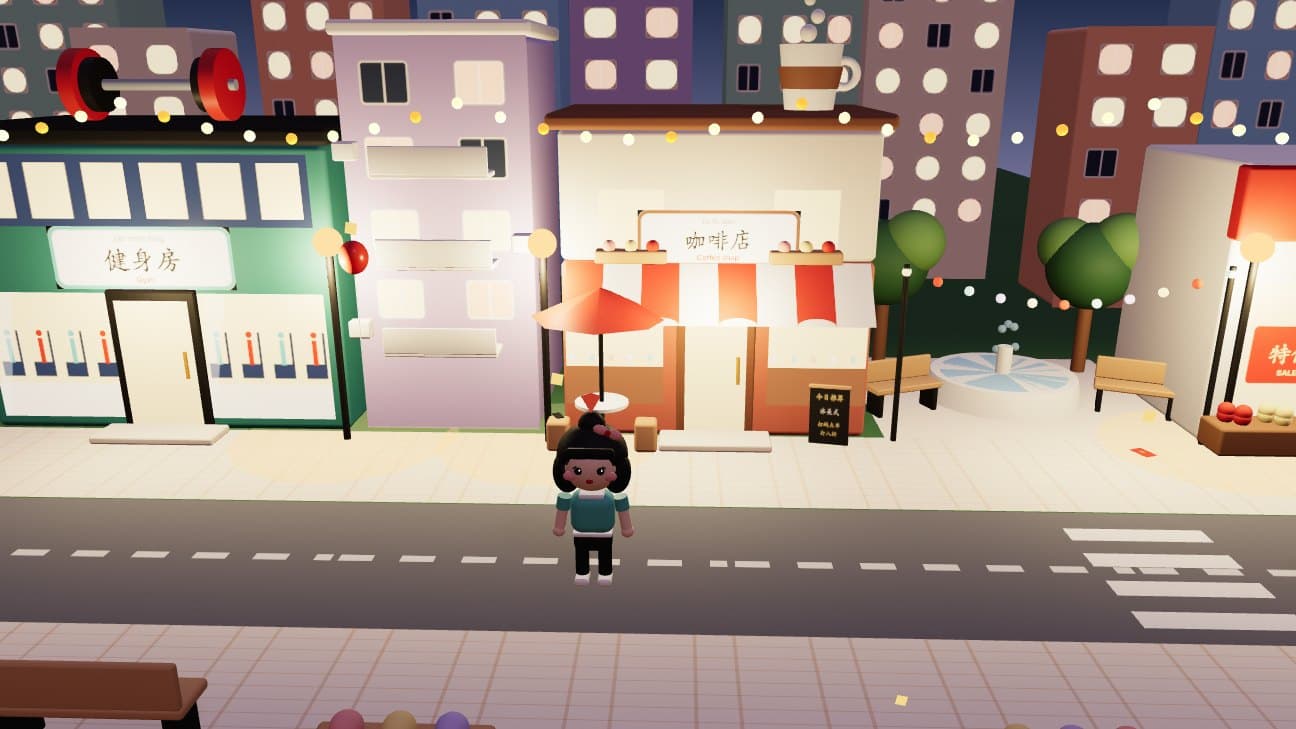
Town: out on the street
Say 请问 before asking a stranger something — it's polite.
Excuse me, where's the toilet?
Facing the shops: your left hand side is 左边, right is 右边.
The toilet is to the left of the lift.
Your right-hand side.
My home is to the right of the bank.
在 A 和 B 中间 = between A and B.
I'm sitting between the two of them.
在……旁边 = right next to.
There's a café next to the supermarket.
往 + direction + 走: walk left / right / straight on.
Walk 200 metres ahead and you're there.
路口 = a crossroads. 过了……就是 = just past it, you're there.
My home is just past the traffic lights.
When someone says 谢谢, answer 不客气.
— Thank you! — You're welcome.
Scan a QR code with your phone.
This shop takes orders by QR code.
Open the lock. Scan a shared bike's code and it unlocks.
My bike won't unlock.
骑 = ride (sitting on it): 骑车, 骑马.
I ride my bike to work every day.
Park the bike and lock it in the app when you're done.
You're only charged after you return the bike.
The marked box on the ground where shared bikes must be parked.
There's a bike parking spot at the crossroads ahead.
一块五 = one yuan fifty, ¥1.5.
A bottle of water is 2.50.
小 before an animal sounds cute: 小猫, 小狗.
We have a kitten at home.
A red packet with money in it — given at New Year and weddings, and sent on WeChat too.
Grandma gives me a red envelope at New Year.
What you open doors and locks with.
I can't find my keys.
What you hold up when it rains.
I forgot my umbrella.
手 hand + 机 machine: the machine in your hand.
My phone's dead.
A little bag for money.
There's no cash in my wallet.
A ball filled with air — it floats.
Kids love balloons.
The person a pet belongs to is its 主人.
Who does this puppy belong to?
Little things you wear in your ears to listen to music.
I wear earphones on the metro.
忘 = forget. 把…忘在… = leave something behind somewhere.
I left my phone at home.
掉 = fall down from somewhere.
I dropped my keys.
Cards, tickets, paper and photos are counted with 张.
I bought two cinema tickets.
Long thin things like pens and lipsticks are counted with 支.
I have three pens.
Clothes, trousers and shoes take 穿.
It's cold today — wear more.
Hats, glasses, headbands and watches take 戴, not 穿.
I wear glasses.
A knitted top for cold days.
This sweater is very warm.
The top layer you wear outside.
Put on a jacket when you go out.
Here it is read bēi: to carry something on your back.
He carries his laptop on his back to work every day.
衣服 = clothes in general.
I want to buy some new clothes.
Hats are counted with 顶: 一顶帽子.
I bought a new hat.
A woven straw hat for summer.
Wear a straw hat to the beach in summer.
Tops are counted with 件: 一件T恤, 一件外套.
I bought two shirts.
Trousers for sport. 裤子 = trousers.
These trousers are a bit long.
A thick sporty top, often with a hood.
It's getting cold — wear a hoodie.
A top with a collar and buttons.
You wear a shirt to work.
Strong blue trousers.
I wear jeans every day.
Skirts, trousers and scarves are counted with 条.
I have three skirts.
A knitted hat — warm in winter.
It's snowing — put on a woolly hat.
What you wear when you can't see clearly.
I wear glasses when I read.
Dark glasses for strong sun.
Take sunglasses to the beach in summer.
With a scarf you don't say 穿 or 戴 but 围: wrap it round your neck.
It's cold — wrap your scarf on.
换上 + clothes = take one thing off and put another on.
It's raining — put on your rain boots.
Clothes you wear to sleep.
My pajamas are blue.