
The Sound System: all 10 lessons free
No sign-up needed, but nothing is saved. Sign up free and your progress and mistake book are kept — carry on from any phone or computer.
This practice works best alongside a lesson: to get your sounds right, book one and your teacher listens and corrects you one-on-one.
One G Apart
差一个 g:前鼻音和后鼻音
因 and 英, 心 and 星, 山 and 伤. Your mouth already makes both sounds every day — today you start noticing which one you made.
Sign up free — just an email. Your wrong answers go into your mistake book, and you can carry on on another device.
Sign up / sign inPronunciation clinic
The part most books leave out: the vowel moves too
You will be told that -n means the tongue tip goes up and -ng means it stays down. True, but it is the quietest part of the syllable and it is not what a Chinese ear catches first. Listen to 山 shān and 伤 shāng: the a in 山 is bright and forward, near the a in 'cat'. The a in 伤 is dark and pulled back, near the a in 'father'. The nasal is the tail; the vowel is the whole animal. Aim your ear at the vowel and the pair separates immediately.
书上会告诉你:-n 是舌尖抬起,-ng 是舌尖放下。没错,但那是整个音节里最轻最短的一段,也不是中国人第一时间抓住的东西。听 山 shān 和 伤 shāng:山 的 a 明亮靠前,接近英语 cat 里的 a;伤 的 a 低沉靠后,接近 father 里的 a。鼻音只是尾巴,元音才是整只动物。把耳朵对准元音,这两个字立刻就分开了。
Four pairs — listen, do not repeat yet
Play each pair twice before moving on. Listen for the vowel, not the ending.
Tap any line to hear it
Ears only — which one did she say?随堂小练
No pressure — just making it stick.
Which character did you hear?
Which character did you hear?
Which character did you hear?
Which character did you hear?
Pronunciation clinic
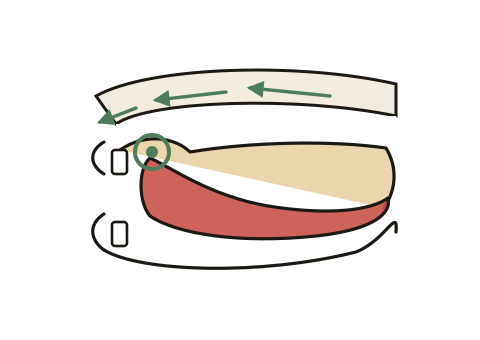
-n: the tongue tip goes up and the mouth closes
Say 因 yīn and freeze at the end. Your tongue tip is pressed against the ridge just behind your upper teeth, and your mouth is almost shut. Check in a mirror: for -n you can barely see inside. Put one finger on your chin — it stays high.
念 因 yīn,在结尾处停住不动。你的舌尖正顶在上牙后面那道牙龈上,嘴几乎是闭着的。照镜子看:发 -n 的时候你几乎看不到嘴里面。手指搭在下巴上——下巴是抬着的。
Pronunciation clinic
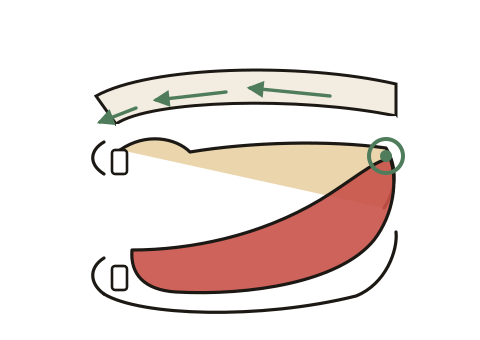
-ng: the tongue tip drops and the back rises
Now say 英 yīng and freeze. Your tongue tip is touching nothing — it is lying flat behind your lower teeth — while the back of your tongue has lifted to meet the soft palate, and your mouth is open. In the mirror you can see your tongue. The finger on your chin drops. That drop is the easiest thing to feel, and it is a reliable test: if your jaw did not move, you said -n.
现在念 英 yīng,也停住。你的舌尖什么都没碰到——它平躺在下牙后面——而舌根抬起来顶住了软腭,嘴是张开的。照镜子能看见舌头。搭在下巴上的手指会往下掉。下巴那一掉是最容易感觉到的,也是个很可靠的自检:如果下巴没动,你刚才发的是 -n。
Both nasals, one word — words you already own
Say each one slowly and feel your jaw move between the two syllables.
Tap any line to hear it
Front or back? Listen and sort随堂小练
No pressure — just making it stick.
The SECOND syllable — front nasal or back nasal?
The SECOND syllable — front nasal or back nasal?
The SECOND syllable — front nasal or back nasal?
The three that cost you
Same tone in each pair, so the nasal is the only thing carrying the meaning.
Tap any line to hear it
Now say it — the microphone is listening随堂小练
No pressure — just making it stick.
Your turn — say it
星期
week
Your turn — say it
银行
bank
Your turn — say it
中文
the Chinese language
Before you go课后回顾
- Put a finger on your chin and say 因 / 英 ten times, alternating. If the finger never moves, you are saying the same sound twice — and that is worth knowing.
- Which of the four pairs was hardest to HEAR? For most people it is 真 / 争. Tell me yours and we will start there next class.
- Say 银行 into the microphone once a day this week. It is the word with both nasals in it, so if that one is clean, the rest follow.