
What 就 actually means (and why 就 and 才 are not opposites)
Dictionaries give you just, then, only and already for 就, which is why they don't help. One idea behind the word explains every use of it.
珂Teacher Jane · September 6, 2026 · 5 min read

一以贯之
“One thread runs through it all.”
A learner posted a cry for help online last week. Half a million people read it. He had made his peace with tones, with measure words, even with 了. But one word had beaten him:
就.
He listed his evidence, and every sentence was correct Chinese:
- 我马上就来。
- 三岁就会说话了。
- 你怎么现在就走?
- 我就看看。
- 我就是不想去。
He looked 就 up. The dictionary offered just, then, only, already, exactly. He asked his Chinese friends. They thought about it for a while and said, "It… means 就."
They weren't being unhelpful. 就 is one of those words native speakers use forty times a day and have never once had to define. So here is the definition.
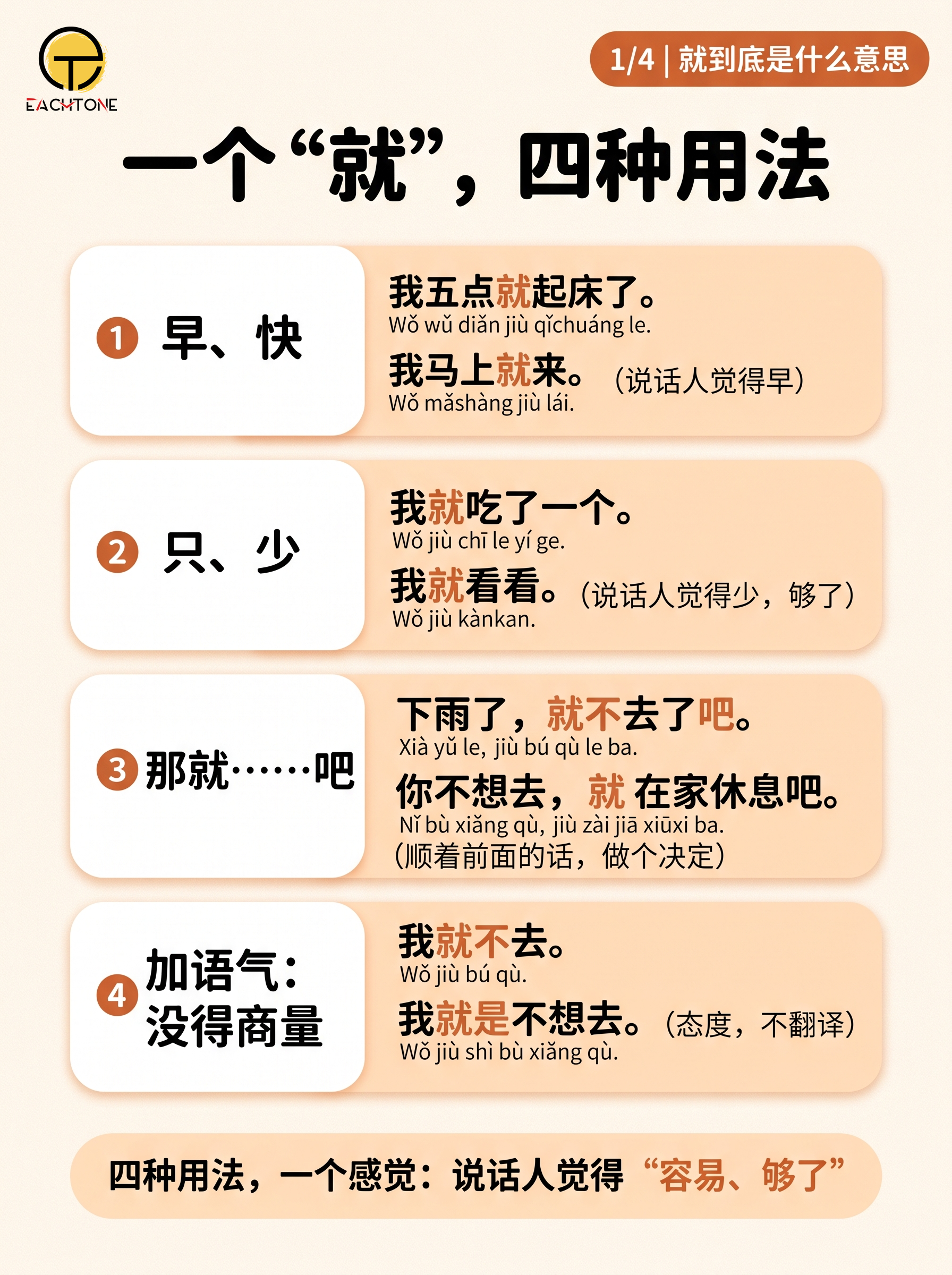
The one idea
就 is not a meaning. It is an attitude. It tells you the speaker feels that something was easy, early, or enough — that whatever we were heading towards, we have already got there, and there is no need to go further.
Hold that thought against his five sentences:
- 我马上就来 — I'll be there; no distance left to cover.
- 三岁就会说话了 — three years old was already enough to be talking.
- 你怎么现在就走 — you're leaving, and we've barely started.
- 我就看看 — looking is enough; I don't need to buy.
- 我就是不想去 — that's the whole answer; don't ask again.
Same feeling every time. The English translation changes because English has no single word for it, not because 就 has changed.
Where it shows up
In practice you'll meet it in four shapes.
Early or fast. 我五点就起床了 (I was up at five — early). 他一个小时就到了 (he got there in an hour — quick).
Only, and that's fine. 我就吃了一个 (I only ate one). 我就看看 (just looking).
Then, in that case. 下雨了,就不去了吧 (it's raining, so let's not go). 你不想去,就在家休息吧 (if you don't want to come, stay home and rest). Here 就 follows on from what was just said and settles it.
Attitude, untranslatable. 我就不去 (I'm not going, and that's that).
就 and 才: the same fact, two opinions
This is the pair that makes 就 click, and it is the heart of the HSK 3 syllabus on the word.
- 就 = the speaker thinks it was early, fast, smooth.
- 才 = the speaker thinks it was late, slow, difficult.
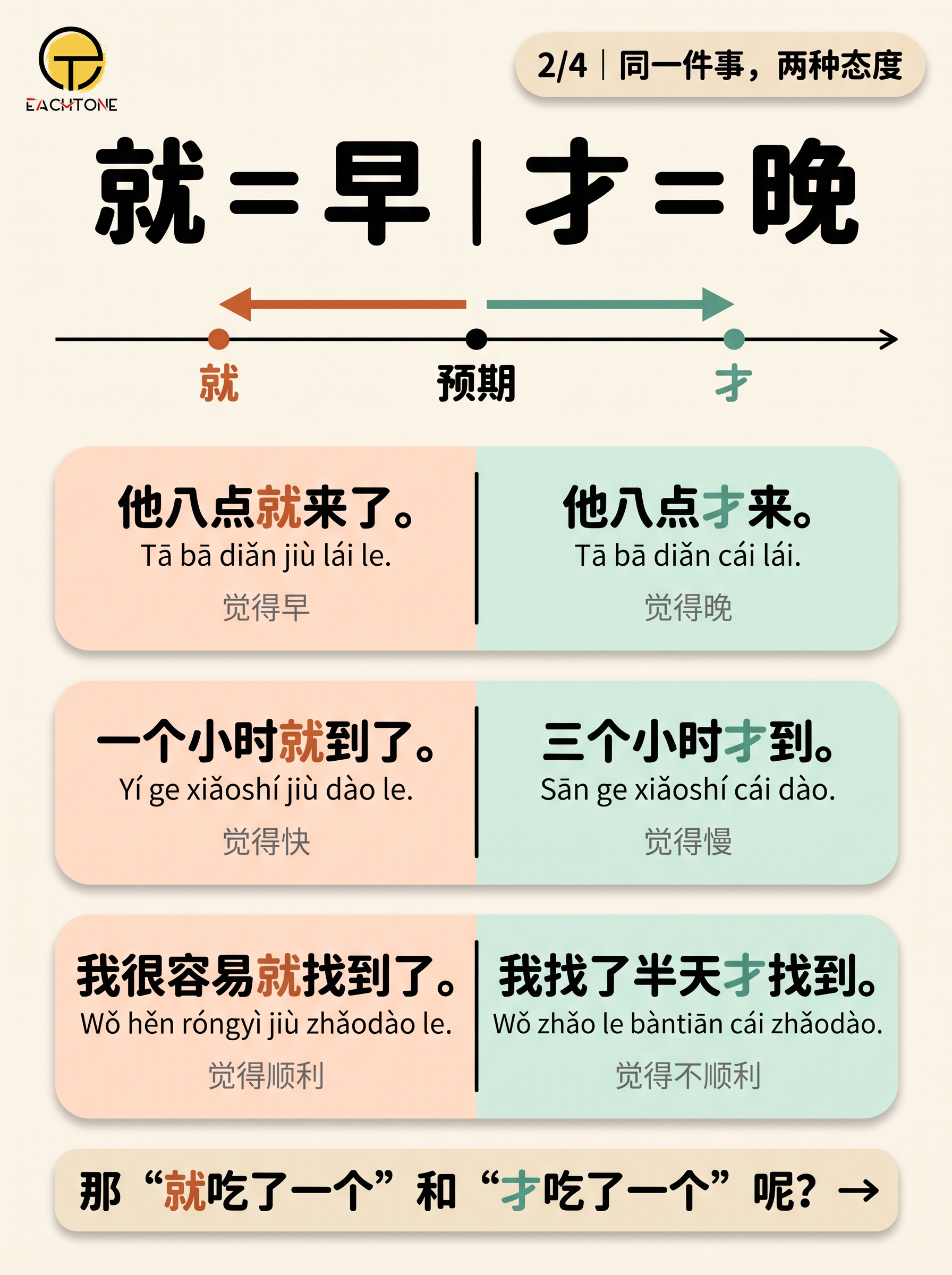
| 就 | 才 |
|---|---|
| 他八点就来了。He came at eight (early). | 他八点才来。He didn't come until eight. |
| 一个小时就到了。An hour and we were there. | 三个小时才到。It took three whole hours. |
| 我很容易就找到了。Found it easily. | 我找了半天才找到。I hunted for ages before I found it. |
Look at the first row. The time is identical. Eight o'clock both times. The only thing that changed is whether the speaker thinks eight o'clock is impressive or annoying.
This is why 就 and 才 feel slippery to learners and obvious to native speakers. They aren't reporting facts. They are reporting an opinion about a fact.
The puzzle that broke him
Our learner spotted something genuinely strange, and he was right to.
你怎么现在就走? = you're leaving too early 你怎么现在才走? = you're leaving too late
So they're opposites. Fine. But then:
我就吃了一个。 我才吃了一个。
Both feel like I only ate one. How can two opposites both mean "only"?
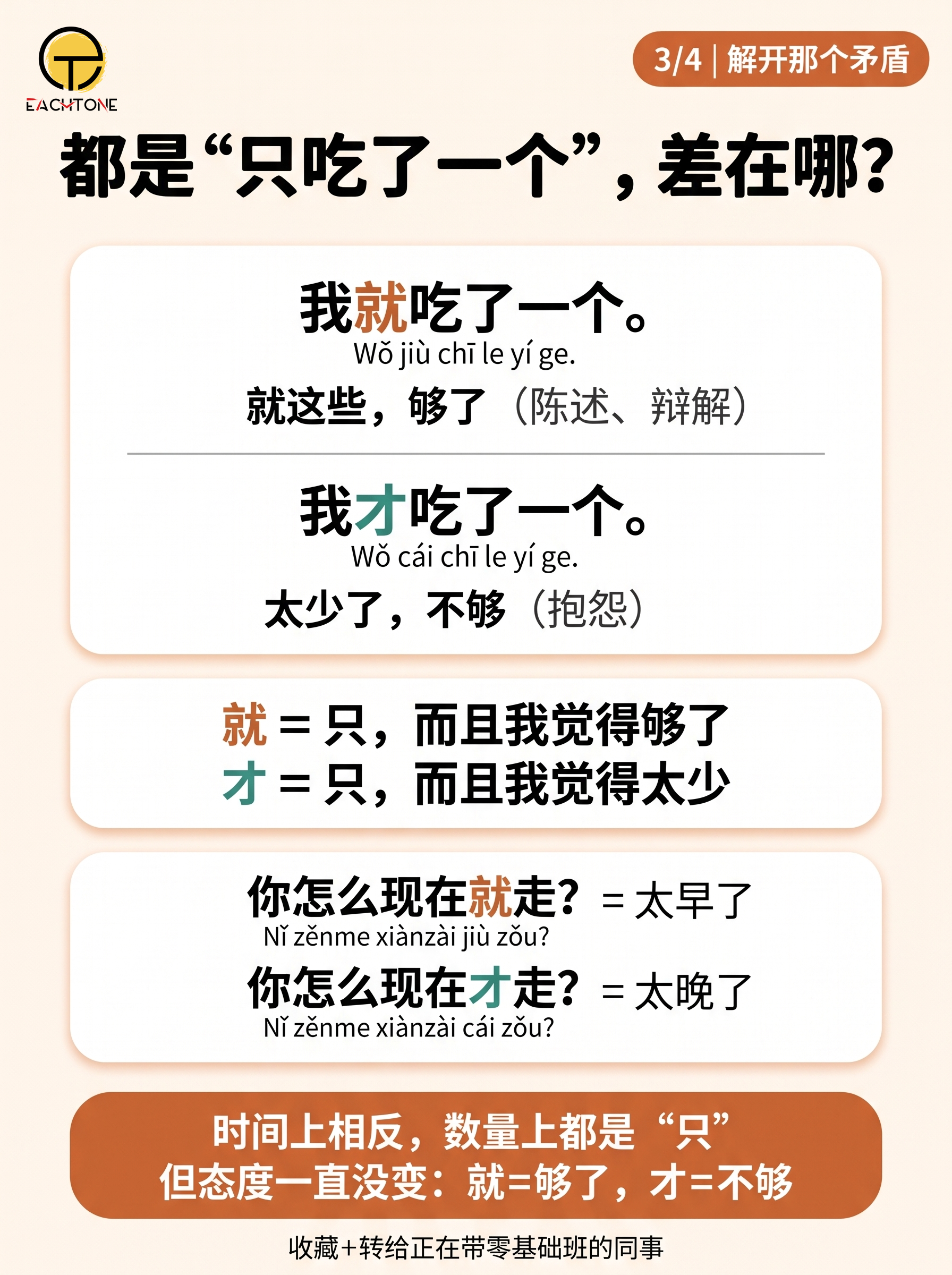
The answer is that nothing has changed. The attitude has been constant the whole time:
- 就 = only — and I think that's enough. 我就吃了一个 is a statement, often a defence: I only had one, don't look at me like that.
- 才 = only — and I think that's not enough. 我才吃了一个 is a complaint: I've only managed one, I'm still hungry.
Project "enough versus not enough" onto time and you get early versus late. Project it onto quantity and you get modest versus insufficient. One attitude, two dimensions. They only look like opposites because time runs in a direction and amounts don't.
我不去 versus 我就不去
His last question was the sharpest one: what is the difference, and please don't tell me 就 = just.
- 我不去。— I'm not going. A fact.
- 我就不去。— I'm not going. Don't bother arguing.
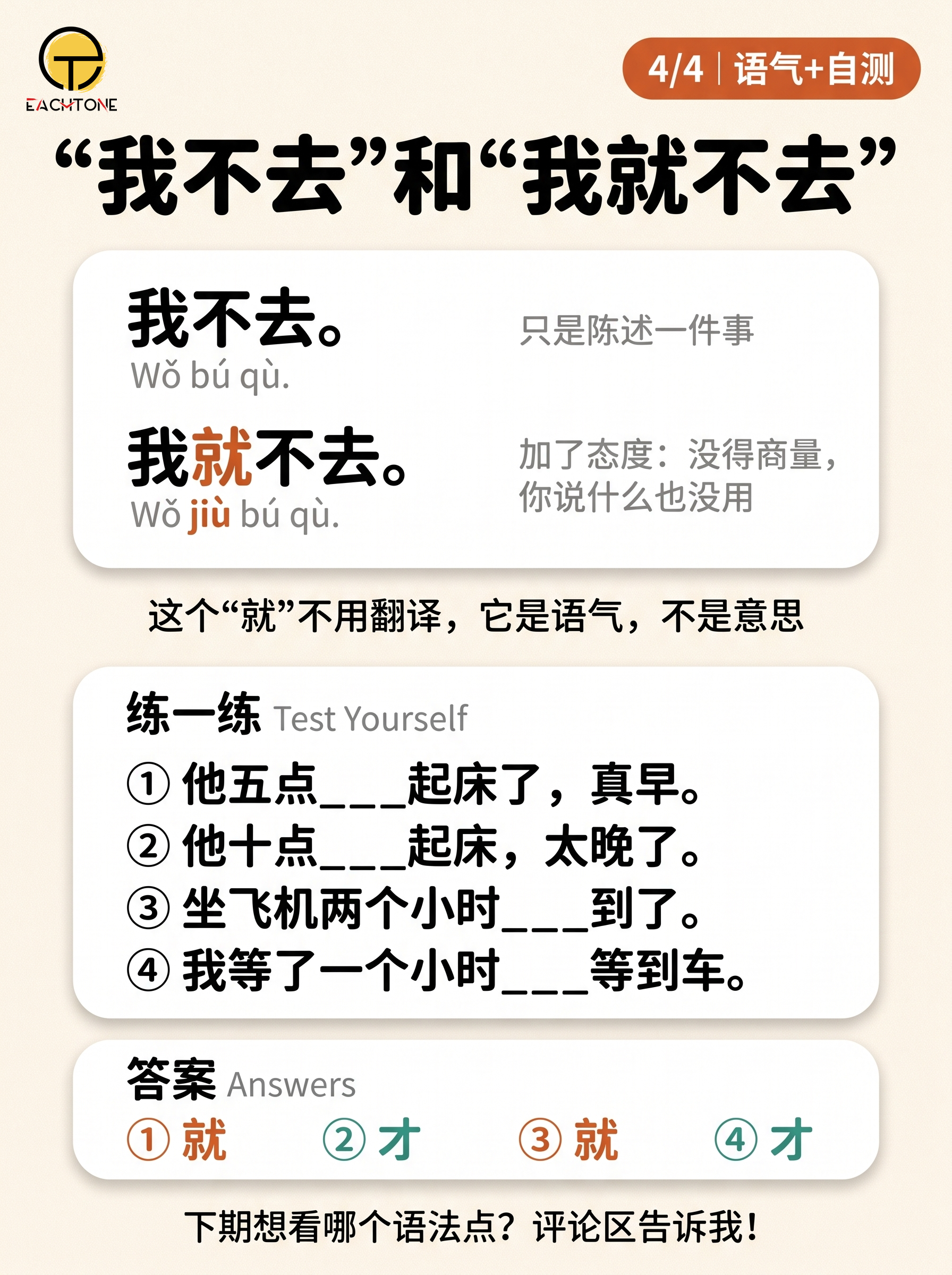
That 就 has no translation because it isn't carrying meaning — it's carrying tone. It's the difference between saying no and folding your arms while you say it. Stress it when you speak: 我 就 不去.
You'll meet the same 就 in 我就是不想去 (I simply don't want to), 我就要这个 (this one, no other), and 你就不能早点来吗?(could you not have come earlier?).
The moment you stop hunting for an English equivalent, this use becomes easy. There isn't one. It's a shrug, or a foot put down.
Four frames worth memorising whole
Rather than parsing 就 every time, learn these as single units.
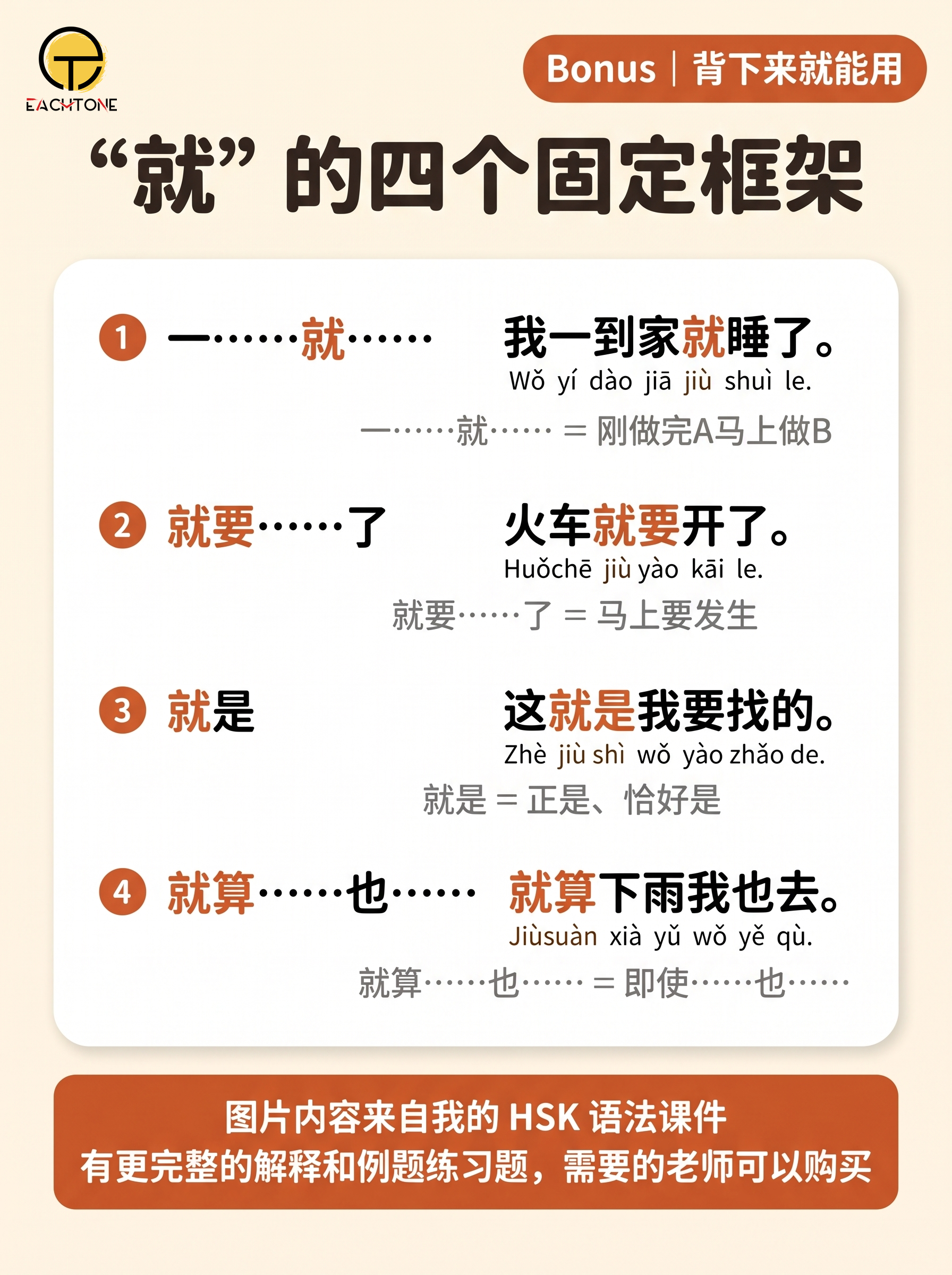
- 一……就…… — 我一到家就睡了。 The moment I got home I went to sleep.
- 就要……了 — 火车就要开了。 The train is about to leave.
- 就是 — 这就是我要找的。 This is exactly the one I wanted.
- 就算……也…… — 就算下雨我也去。 Even if it rains, I'm going.
That third one deserves a note, because learners use it constantly without noticing what it does. 这是我家 introduces your home. 这就是我家 says here we are — this is the place, and it only works if your listener was already expecting it. Same with 这就是我男朋友: it means this is the one I told you about, not merely this is my boyfriend.
Two rules that will save you marks
One. Sentences with 就 take 了 at the end; sentences with 才 don't.
- 我五点就起床了。✓
- 我十点才起床。✓ (not 起床了)
Two. In front of a number, 才 stops meaning late and starts meaning only.
- 今天怎么才三个菜? Only three dishes today?
- 我才三天就找到工作了。 It only took me three days to find a job.
Both 才 in that last sentence and 就 in it are doing exactly what we said: 才三天 = that's barely any time, 就找到了 = and that was enough to get there.
Stop translating it
The reason 就 defeats people is that they keep asking which English word is this. There isn't one, and four half-answers stitched together make a worse map than no map.
Ask instead: does the speaker feel this was easy, early, enough — or difficult, late, not enough? First one, 就. Second one, 才. That single question covers early/late, fast/slow, only-and-fine/only-and-not-fine, and most of the attitude uses too.
Your Chinese friends were closer than they realised. 就 does mean 就. It just turns out that 就 means "and that was that."
There's a printable 就/才 sheet in the free materials — the timeline, the six paired sentences above, and a short judgement drill with answers on the back.
Teacher Jane · Jane老师
Mandarin teacher (M.TCSOL), 500+ students from 20+ countries. I write the way I teach — practically, and with snacks.