
穿 or 戴? The wear word Chinese splits in two
English has one word for wear. Chinese has two, and the line between them is about your body, not about formality. Here is the rule in one picture.
珂Teacher Jane · September 6, 2026 · 4 min read

量体裁衣
“Measure the body, then cut the cloth.”
The official HSK vocabulary list puts 戴 — the word for wearing a hat — at level 4. Roughly two thousand words in. It does not contain 雨伞 (umbrella) at all, or 刷牙 (brush your teeth), and it files 钥匙 (key) at level 4 as well.
That tells you something useful about word lists, and nothing at all about what you need on your second day in Beijing. You will want to say put your hat on long before you sit HSK 4. So let us do it now.
One English word, two Chinese ones
English has wear, and it covers everything: a coat, shoes, glasses, a ring, perfume, a smile.
Chinese splits that job between two verbs, and the split is not about formality or politeness. It is about your body.
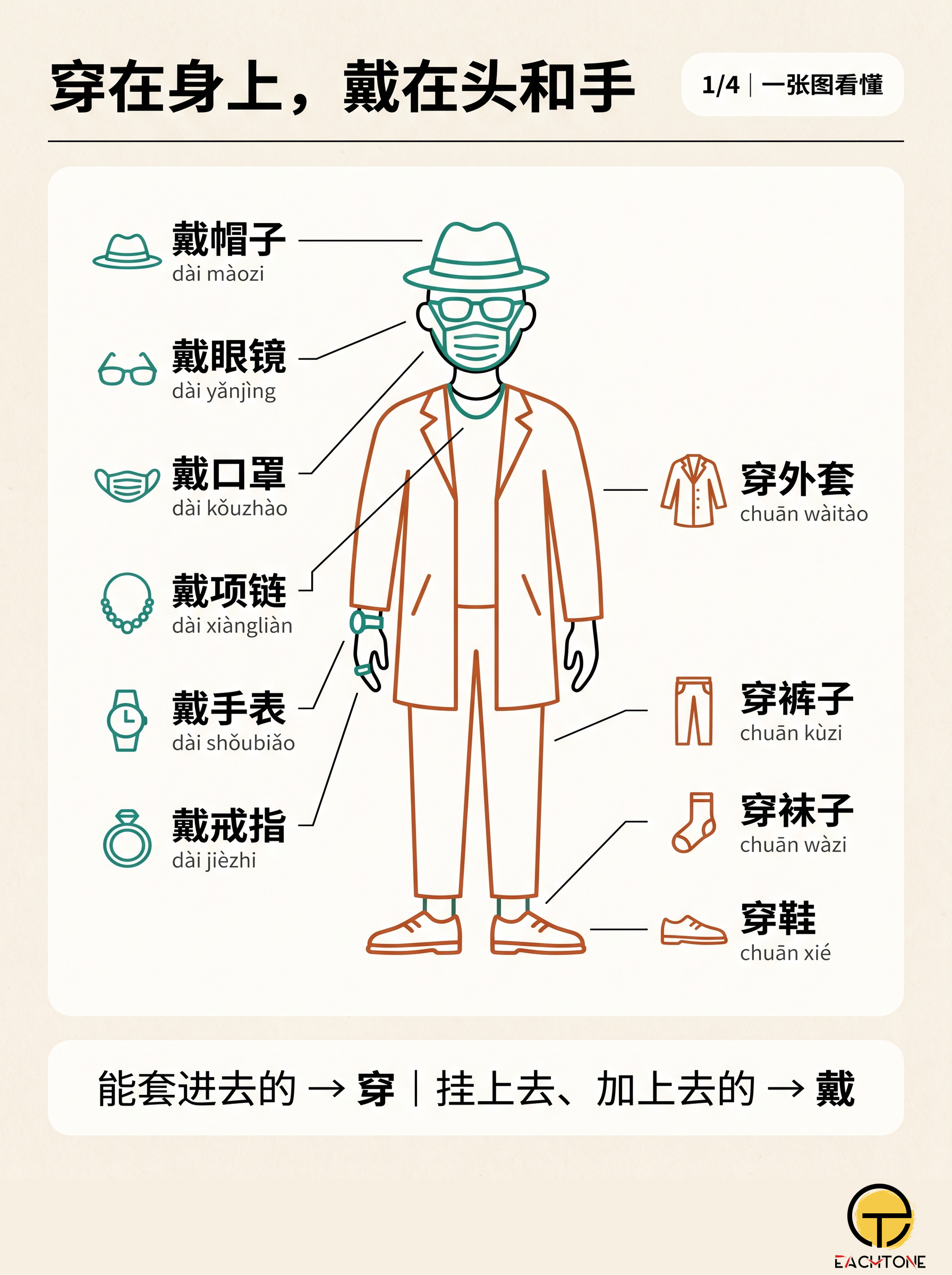
- 穿 chuān — things your body or limbs go into. Arms through sleeves, legs through trousers, feet into shoes.
- 戴 dài — things that go onto you. Perched, hooked, strapped or hung on your head, face, neck, wrist or fingers.
That is the entire rule. Once you have it, you can classify a wardrobe you have never seen before.
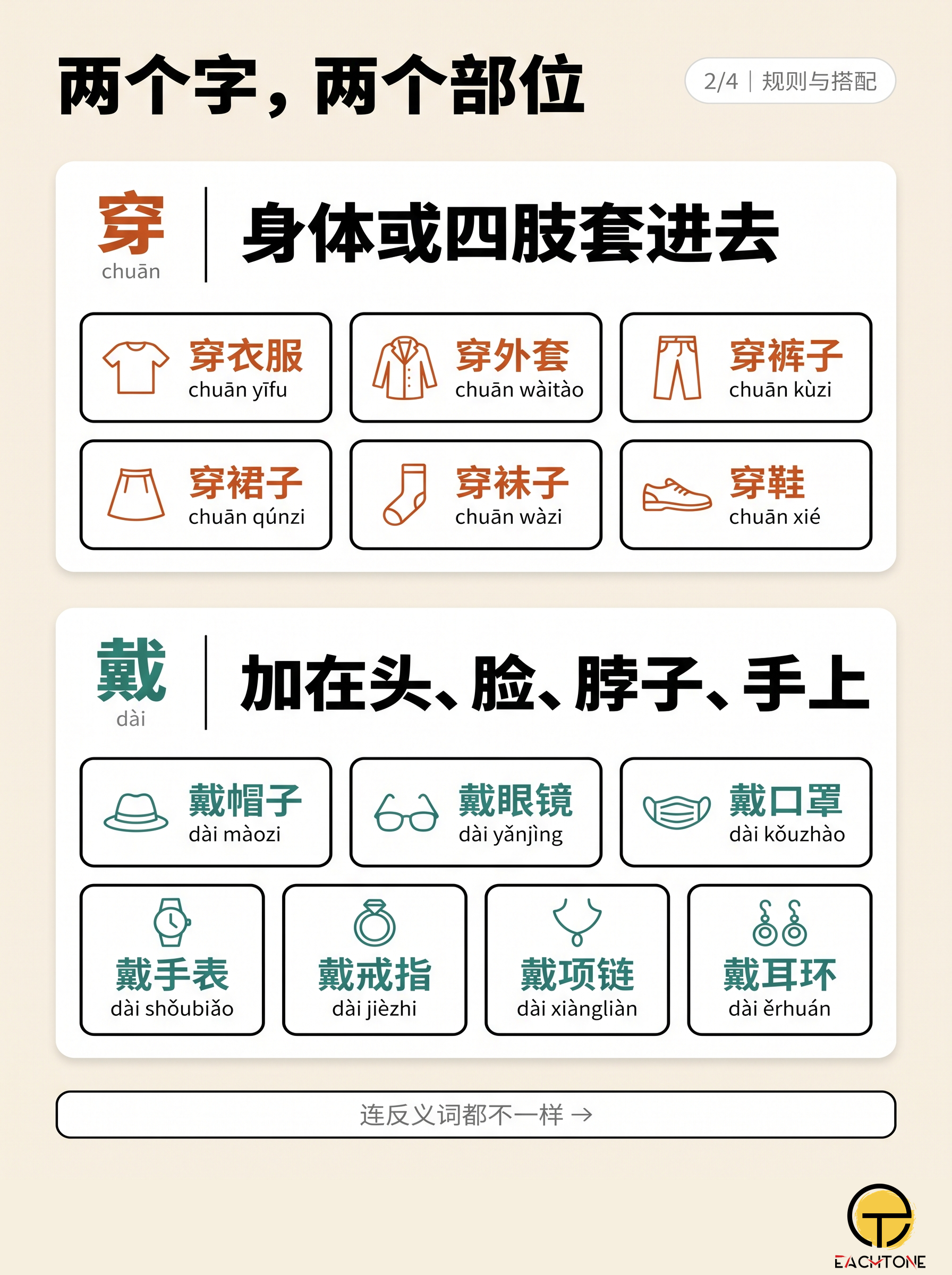
What goes with 穿
Anything you put your body inside.
穿衣服 (clothes) · 穿外套 (a coat) · 穿裤子 (trousers) · 穿裙子 (a skirt) · 穿袜子 (socks) · 穿鞋 (shoes)
Notice socks and shoes. Your foot goes in, so it is 穿 — even though they sit at the far end of you, nowhere near your torso. The rule is about entry, not about location.
What goes with 戴
Anything that is added onto you.
戴帽子 (a hat) · 戴眼镜 (glasses) · 戴口罩 (a face mask) · 戴手表 (a watch) · 戴戒指 (a ring) · 戴项链 (a necklace) · 戴耳环 (earrings)
These are attachments. Nothing of yours passes through them; they simply rest on you.
The four mistakes everyone makes
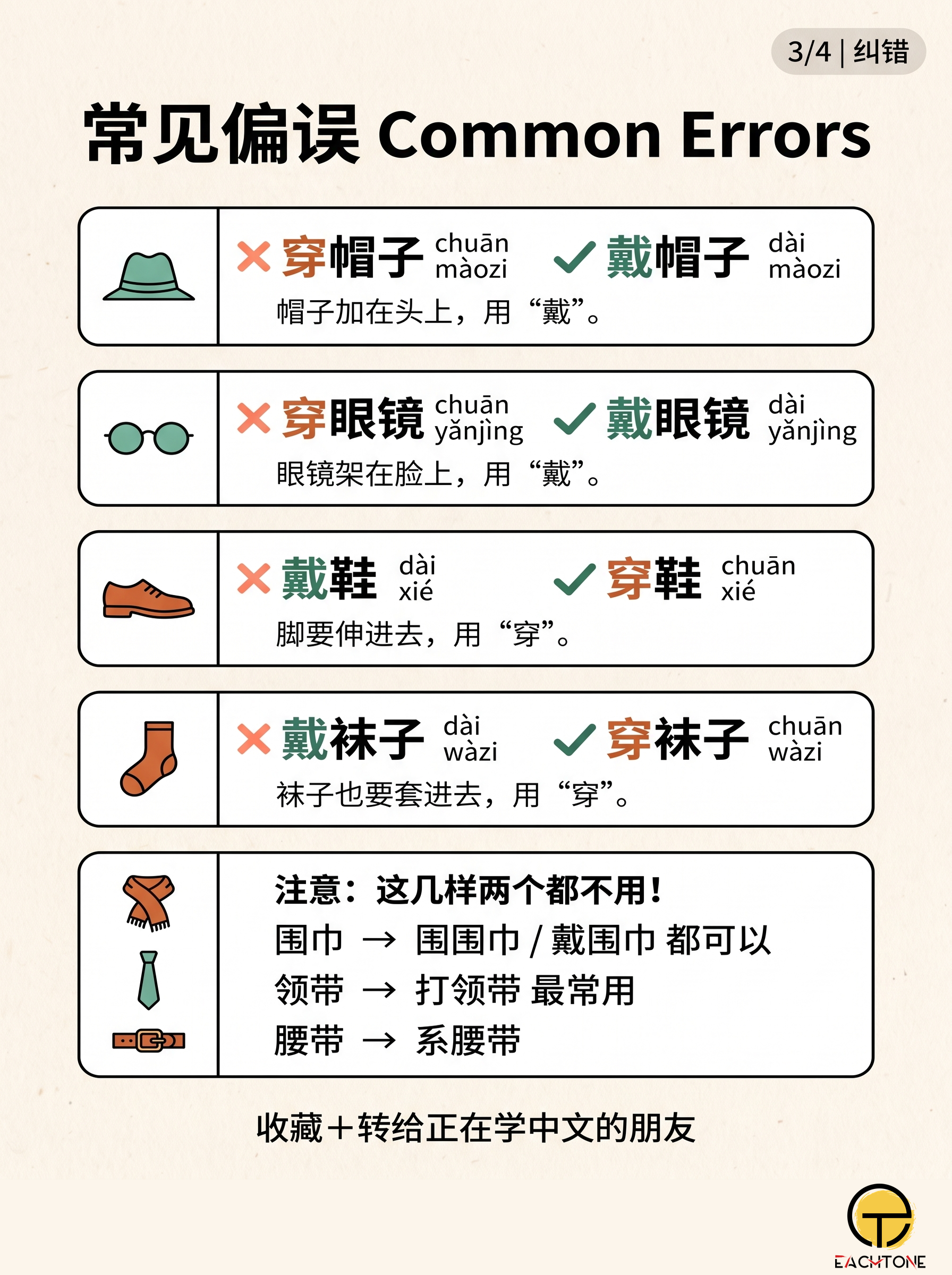
✗ 穿帽子 → ✓ 戴帽子. A hat sits on your head. Nothing goes into it.
✗ 穿眼镜 → ✓ 戴眼镜. Same reasoning: glasses perch on your face.
✗ 戴鞋 → ✓ 穿鞋. Your foot goes inside, so shoes are 穿 — this is the one native speakers notice most sharply.
✗ 戴袜子 → ✓ 穿袜子. Socks too. Foot in, therefore 穿.
If you only remember one of these, remember shoes. Saying 戴鞋 marks you out instantly, in the way that I am wearing my shoes on would in English.
Three things that take neither
Chinese has a habit of giving certain objects their own dedicated verb, and clothing is full of them. These three are worth learning as fixed pairs:
- 围巾 (a scarf) → 围围巾, literally to encircle. 戴围巾 is also heard and is fine.
- 领带 (a necktie) → 打领带, literally to tie. Not 穿, not 戴.
- 腰带 / 皮带 (a belt) → 系腰带, to fasten.
Do not try to reason these out from the body rule. They are collocations; learn the verb and the noun together, the way you learn make a decision rather than do a decision in English.
The opposites are different too
This is the part most textbooks skip, and your students will need it the same day they need the verbs.
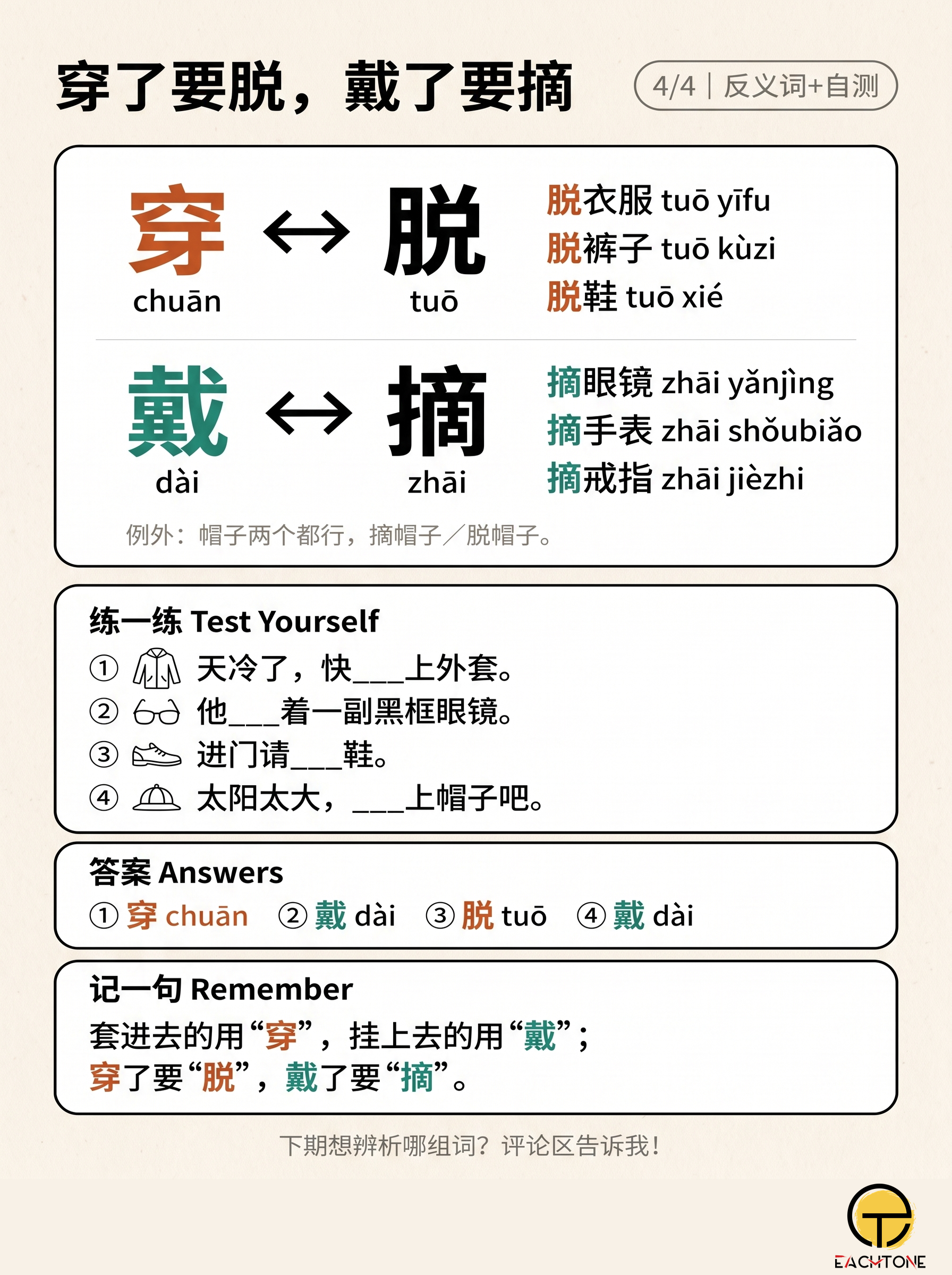
- 穿 ⟷ 脱 tuō — 脱衣服, 脱裤子, 脱鞋. Taking off what your body was inside.
- 戴 ⟷ 摘 zhāi — 摘眼镜, 摘手表, 摘戒指. Removing what was attached to you.
✗ 脱眼镜 is wrong; you want 摘眼镜.
The one exception is hats, which take both: 摘帽子 and 脱帽子 are equally good, and 脱帽 survives as a set phrase meaning hat off in the respectful sense.
At the door of a Chinese home you will hear 请脱鞋 — please take your shoes off — constantly. It is worth being able to hear it the first time rather than the fifth.
One thing to notice: 手套
Gloves are the one item that argues with the rule. Your fingers clearly go into them, which should mean 穿. Chinese says 戴手套.
The usual explanation is that gloves are treated as an accessory of the hand, in the same family as watches and rings, rather than as clothing. Whatever the history, this is the single item you have to memorise against the pattern — and being told that in advance saves your students the frustration of deducing the rule correctly and still being wrong.
Practise it on yourself
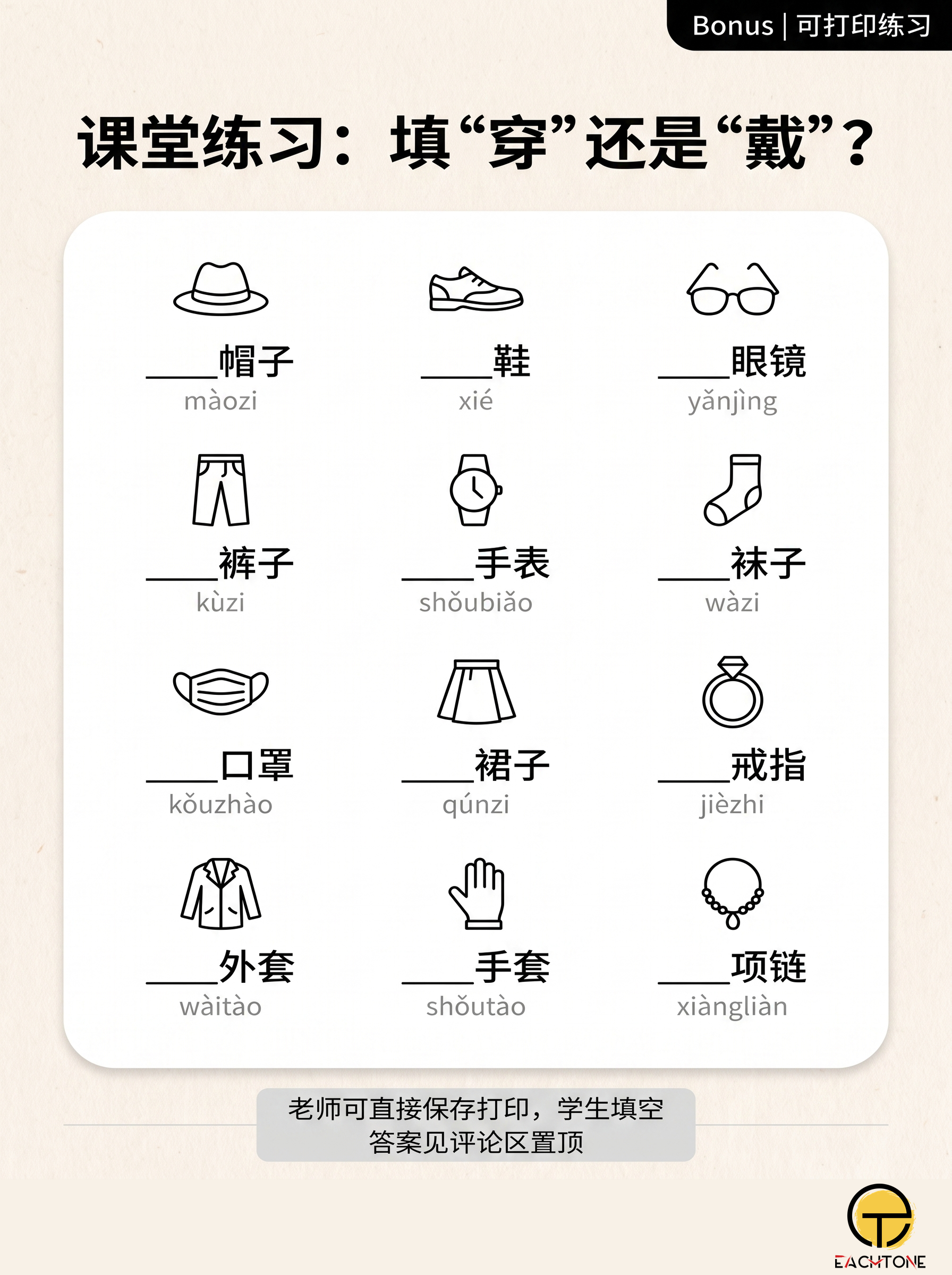
The fastest way to fix this is not flashcards. It is describing yourself out loud, right now, from head to feet:
我戴着眼镜,戴着手表,穿着一件衬衫、一条裤子和一双袜子。
Then do the same for the person opposite you on the train. Two weeks of that and the choice stops being a choice — you will simply hear that 穿帽子 is wrong, without being able to say why, which is exactly where you want to end up.
There's a printable version of the picture above in the free materials — the labelled figure on the front, and a fill-in worksheet with twelve items on the back.
Teacher Jane · Jane老师
Mandarin teacher (M.TCSOL), 500+ students from 20+ countries. I write the way I teach — practically, and with snacks.