
Basic Grammar: all 87 lessons free
No sign-up needed, but nothing is saved. Sign up free and your progress and mistake book are kept — carry on from any phone or computer.
This practice works best alongside a lesson: to really get this grammar, book one and your teacher explains it and practises it with you.
Numbers — Ten Words and You Can Count to 99,999
有趣的数字
Chinese numbers are Lego. Learn ten pieces, learn where they stack, and every number up to five digits builds itself.
Sign up free — just an email. Your wrong answers go into your mistake book, and you can carry on on another device.
Sign up / sign inCloned voice — synthesised in a real teacher's timbre, not a recording of her.
The ten pieces
You met these at the market. Tap through them once to warm them up.
Tap any line to hear it
Memory hook
Stack, do not memorise
Watch one number grow
The same 45 sits at the end of every one of these. Nothing about it changes as digits pile up in front.
Tap any line to hear it
Pronunciation clinic
两 for counting, 二 for reciting
两千 liǎngqiān · 两杯 liǎng bēi · 两个人 liǎng ge rén
二十 èrshí · 十二 shí'èr · 二〇二五 èr líng èr wǔ
二 is the number two when you are reading digits out — in a year, a phone number, a room number, or inside 十二. 两 is two when you are counting things, and it is the one that goes in front of 千, 万 and every measure word. 两千 is what people say, 二千 turns up in formal writing — and a bank uses different characters again, 贰仟. Before 百 either works, with 二百 slightly the commoner.
两千 · 两杯 · 两个人
二十 · 十二 · 二〇二五
念数字的时候用「二」——年份、电话号码、房间号,以及「十二」里面。数东西的时候用「两」,「千、万」和所有量词前面都用「两」。日常说「两千」,「二千」出现在正式书面语里——银行写的又是另一套字:贰仟。「百」前面两个都行,「二百」还稍微常一点。
Memory hook
Ten to nineteen drop the one
Memory hook
零 only where a gap is really there
Round 1: build the number第一关:搭数字
No pressure — just making it stick.
45 = 四____五
sì ____ wǔ
45
2345 = ____千三百四十五
____ qiān sānbǎi sìshíwǔ
2,345
Your turn — say it
十二
12
309 = 三百____九
sānbǎi ____ jiǔ
309
Your turn — say it
三百四十五
345
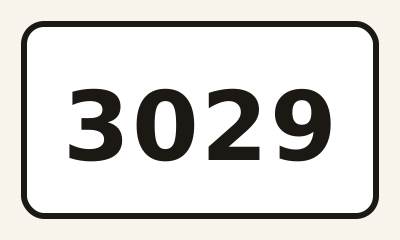
3029 = ____。
3029= ____。
3029 in Chinese.
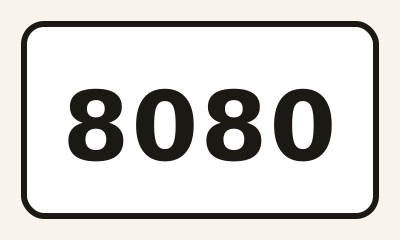
8080 = ____。
8080= ____。
8080 in Chinese.
Round 2: how much is it?第二关:多少钱?
No pressure — just making it stick.
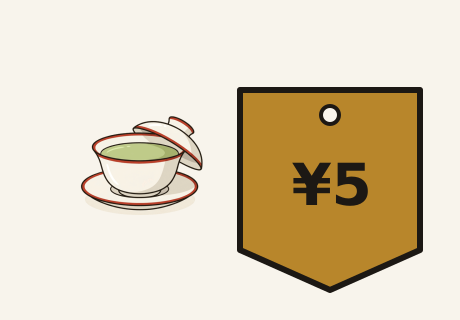
茶多少钱?——____。
chá duō shǎo qián?—— ____。
How much is the tea? — Five kuai.
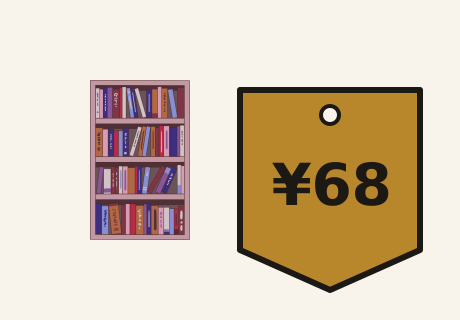
这本书多少钱?——____。
zhè běn shū duō shǎo qián?—— ____。
How much is this book? — 68 kuai.
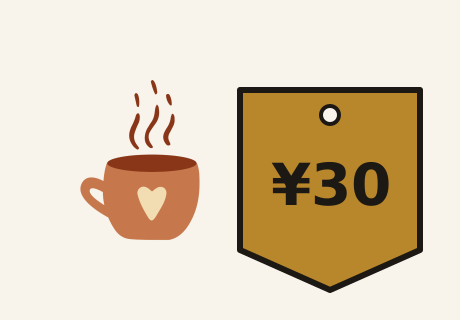
咖啡多少钱?——____。
kā fēi duō shǎo qián?—— ____。
How much is the coffee? — 30 kuai.
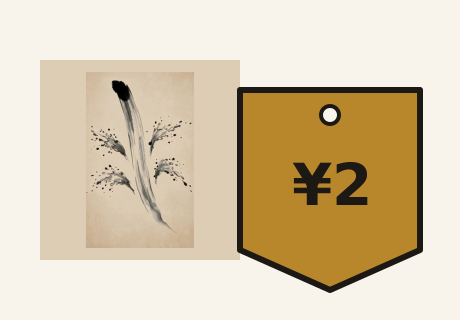
水多少钱?——____。
shuǐ duō shǎo qián?—— ____。
How much is the water? — Two kuai.
手机号里的 1 读作____。
shǒu jī hào lǐ de1 dú zuò____。
In a phone number, 1 is read yāo.
房间号 2012 读作____。
fáng jiān hào2012 dú zuò ____。
Room 2012 is read digit by digit.
This lesson's characters
The stacking words. Two are marks scratched onto something simpler, and one borrows a sound outright.
ten
指a pointer
On the oldest bones it was a single vertical stroke — a tally, one full hand and the other. The crossbar grew out of a thickening in the middle of that line, then a dot, then the bar you write today. Nothing is being drawn here; the stroke just means a count is complete.
hundred
形meaning + sound
白 bái means white, and it is sitting here for its sound alone — bái, drop the tone, bǎi. The 一 across the top says this is a whole unit of something. This is the cleanest phonetic pair in the lesson: the sound part has barely moved in three thousand years.
thousand
指a pointer
Not 十 with a stroke on top, though that is what it looks like now. On the bones 千 is 人, a person, with one stroke laid across the body — and the person was chosen because 人 rén and 千 qiān sounded alike back then. Two strokes meant two thousand, three meant three thousand. The 十 you seem to see is only what the person's leg turned into.
Take these with you
Everything worth taking away. Tap any line to hear it.
Words 生词
Characters 汉字
Before you go课后回顾
- Say your phone number out loud in Chinese, digit by digit. 二 for the twos, not 两 — and in a phone number 1 is said yāo, not yī.
- Read three prices off something near you — a menu, a receipt, a shop window.
- Numbers rarely travel alone. Next lesson: the little word that has to sit between a number and the thing you are counting.